A full day. A private bus. Fifteen Akiya Hunters.16 to 31 January 2027.
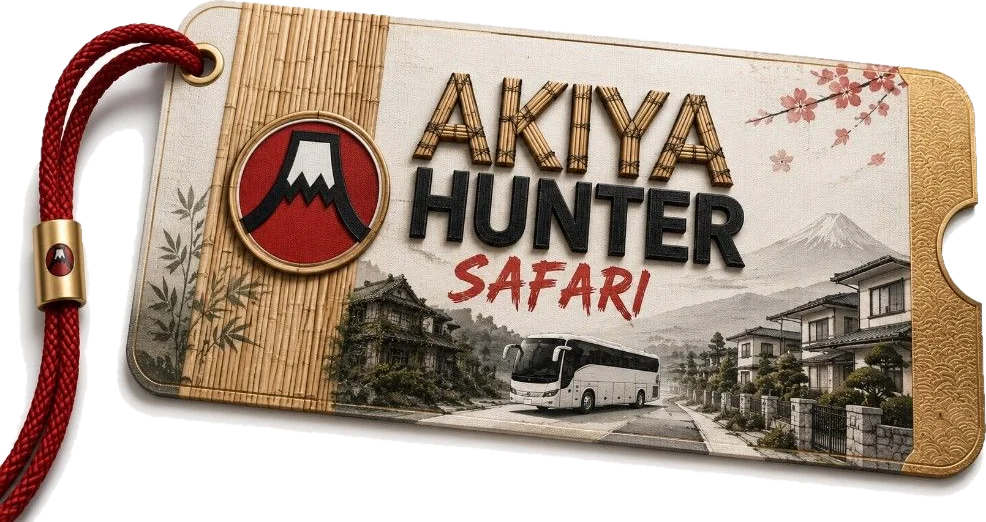
Akiya HunterSafari
Ready to hunt for akiya in Japan with Shu and the AkiyaHub Advisory Team? A full day out of Tokyo on a private bus, five deliberately different properties, dinner back in the city. This is your chance.
Only 15 hunters join each Safari. Applications are reviewed as they arrive.
01
15
Akiya Hunters.
Maximum on the bus, including couples, and the cap does not move.
02
5
Properties planned.
Five standout properties. One day. Our team with you at every stop.
03
Jan 2027
Chiba, date TBA.
Hold 16 to 31 January 2027. We fix the exact day once all fifteen tickets are confirmed.
04
Full day
Plus dinner in Tokyo.
Out early, every hour planned, and a proper meal together once the driving is done.
“Can I just come to Japan and look at some houses?”
The Day Built for Serious Buyers
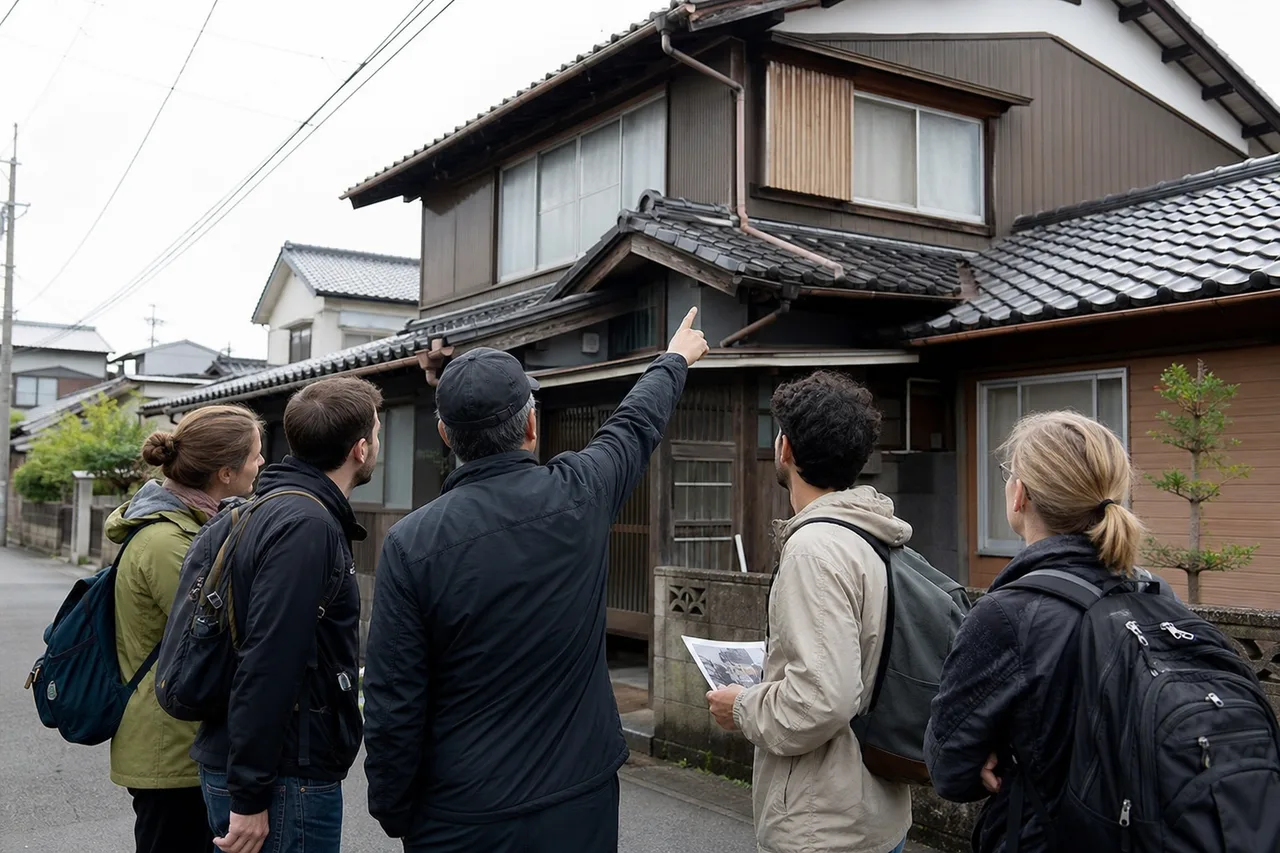
We get some version of that message every week. Someone has been reading listings for a year and wants a day inside real houses. Private viewings are for buyers ready to purchase. This day gives you five homes in different towns, with our team at every stop.
The obvious part
A seller lists a house because they want it sold, not because they want to show it off. An agent works their own patch, in Japanese, on commission, and a day spent driving a stranger between five properties in different towns is not a day that pays them. Most of these houses are empty, and access has to be arranged with an owner who often lives somewhere else entirely.
The part nobody says
Many Japanese agents work only with buyers they can read. Papers, funds, and a plan in Japanese carry a viewing request further than money alone. That is the preparation we bring to every route stop.
A viewing request lands better when the agent can see a buyer with papers, funds, and a plan.
Ready to view is not ready to buy
Put yourself in the agent position. You ask to see a house. They have to judge if the sale can actually happen.
Are your identity papers and notarized affidavit ready? Who handles the Japanese? Who coordinates when you fly home, and who can the agent call here in Japan? Without a Japanese bank account, how will you pay, and how will funds be ready for same day settlement? There is no standard escrow here like the one at home, and most local agents have never arranged one.
A buyer with papers, funds, and a plan is far easier for an agent to say yes to.
What we spent years building
Undoing that takes years, and it is most of what we actually do. Relationships with local agents, city officials and industry contacts, built the slow way: turning up at the office in person, bringing omiyage, doing the introductions properly, and then proving again and again that the buyer on the other end of the line is real. Before we ask about a single property we are usually confirming whether the seller is even open to a foreign buyer, because that question decides everything that follows.
That is the gap we close. We work with the listing agent, we explain who you are and how the purchase can move forward safely, and we coordinate the documents, payment route, calls, contract day, and settlement with licensed professionals.
When we request a viewing, we are spending credibility we had to earn, and we only spend it on people we can vouch for.
300+
Local agents, city officials and industry contacts we have working relationships with.
3+ years
Of in-person groundwork, started before AkiyaHub existed as a company.
Every ticket
Vetted on a call before we approach a single owner about letting the group in.
Why every ticket is chosen
Every hunter is reviewed and selected, so owners know exactly who is coming. We read every application and get on a call with you, so we can tell the owners and agents on this route who is coming: fifteen Akiya Hunters who are genuinely planning to buy in Japan. That promise opens five doors in a single day.
Months of orchestration
Arranging one viewing is already a piece of work. Confirming the property is genuinely still available, establishing whether the seller will deal with a foreign buyer at all, persuading an agent to give up a morning, and reaching an owner who often lives in another prefecture to get an empty house opened.
Now do that five times over, on a single date, with five agents and five owners who have never met each other. Add filming permission at every stop, a chartered bus, a route where the drive times actually work, a table booked back in Tokyo, a crew, and fifteen Akiya Hunters flying in from different countries. Every one of those has to hold at the same time, and if a property sells three weeks out, the sequence gets rebuilt around the gap.
It takes months, which is why there is one of these rather than a schedule of them. Five properties in person, in a single day, is this edition.
All of it, on one date
Five properties still unsold on the day
Five agents giving up the same date
Five owners agreeing to open an empty house
Filming permission from every seller
A bus, a route, and drive times that fit
Fifteen diaries in different countries
So we built the day for it.
Your basecamp for the day has wheels.
We charter a proper Japanese bus and it is yours for the whole day. Reclining seats, curtains, a luggage bay, and a driver who does this for a living. Not a rented van, not a convoy of taxis, and not everyone meeting an agent in a car park in a town they have never heard of.
It turns out to matter more than it sounds. By the third house you have questions, and the twenty-five minutes between stops is where they get answered. The bus is the briefing room, the debrief room and the map table: where the Advisory Team walks you back through what you just saw while it is still fresh, where the group compares scores, and where the questions nobody asks in a public forum finally get asked out loud. By the end of the day it has done as much work as any of the houses.
TokyoPickup
Stop 1Morning
Stop 2Morning
Stop 3Early afternoon
Stop 4Afternoon
Stop 5Late afternoon
TokyoDinner, then home
The whole day, planned for you.
The date is fixed with the group once everyone is confirmed, so treat the timings as the shape of the day rather than a printed schedule. The sequence, though, is the sequence, and it is in this order on purpose.
Two weeks before
On a call, wherever you are
We find out what you are actually looking for
Before anyone gets on a bus, we spend half an hour with you on video. We ask the questions that are difficult to answer honestly on your own: the budget band you can genuinely defend, the compromises you have quietly decided you will not make, the part of buying in Japan that keeps you from moving.
You get a short written brief back. That document is the reason five strangers’ houses turn into information about you rather than a pleasant day out, and it is what the team is holding when they walk you through each property.
Morning
One pickup point in Tokyo
Everyone gets on the bus
We meet at a single point in central Tokyo and leave together. No trains to work out, no rental car, no meeting an agent in a car park in a town you have never heard of. From that moment until you are dropped back in the evening, the day is arranged.
Late morning
The first two houses
You learn how to read a house on the easy one
The first stop is deliberately the most straightforward property of the day. We walk it slowly, out loud, in order: what the light does, where the noise comes from, how the plan actually flows against how it reads on paper, what the wear is telling you, and what a builder would want to look at before anyone signs anything.
You are holding the same field guide the team uses, one page per house, and you fill it in while you are standing in the room. The second house is where it starts paying off, because now you have something to compare against instead of a memory.
Afternoon
Three more stops
The ones that change people’s minds
The afternoon is built for contrast. Something that photographs beautifully with a list of problems behind the cupboard doors. Something nobody would click on that turns out to be the smartest thing you see all day. Something with a real renovation load, so you can put a number and a timeline against a word you have only read.
This is also where the group starts comparing notes out loud. Two people will have scored the same room four points apart, and the twenty-five minutes between stops working out why is one of the more useful parts of the day.
There is no lunch stop. Five properties in a day only works if the bus keeps moving, so snacks and water are on board and we eat properly in the evening. Come with breakfast in you, and bring something of your own if you know you will want it.
Evening
Back in Tokyo
Dinner and the debrief
The bus brings everyone back into Tokyo and dinner is there, not out in the countryside, so nobody is watching a clock or worrying about the last train home. It is included, and it is not a formality.
We go around the table: which property surprised you, which kind you would want to see more of, which one you would never open a listing for again. Hearing fourteen other people answer the same question is what turns a day of impressions into a position you can defend. Then it opens up. Purchase taxes and the ongoing cost of owning, how funds actually move for a cash purchase, what a foreign buyer can and cannot do here, what happens between an accepted offer and a key, and how long all of it really takes.
Within a week
A private call, just you
Your 90-day plan
A day like this is worth very little if it evaporates on the flight home. So we get back on a call with you privately and turn it into a written 90-day plan: your criteria revised against what you actually reacted to, the areas worth your attention, an honest read on your budget, and the next three things you do.
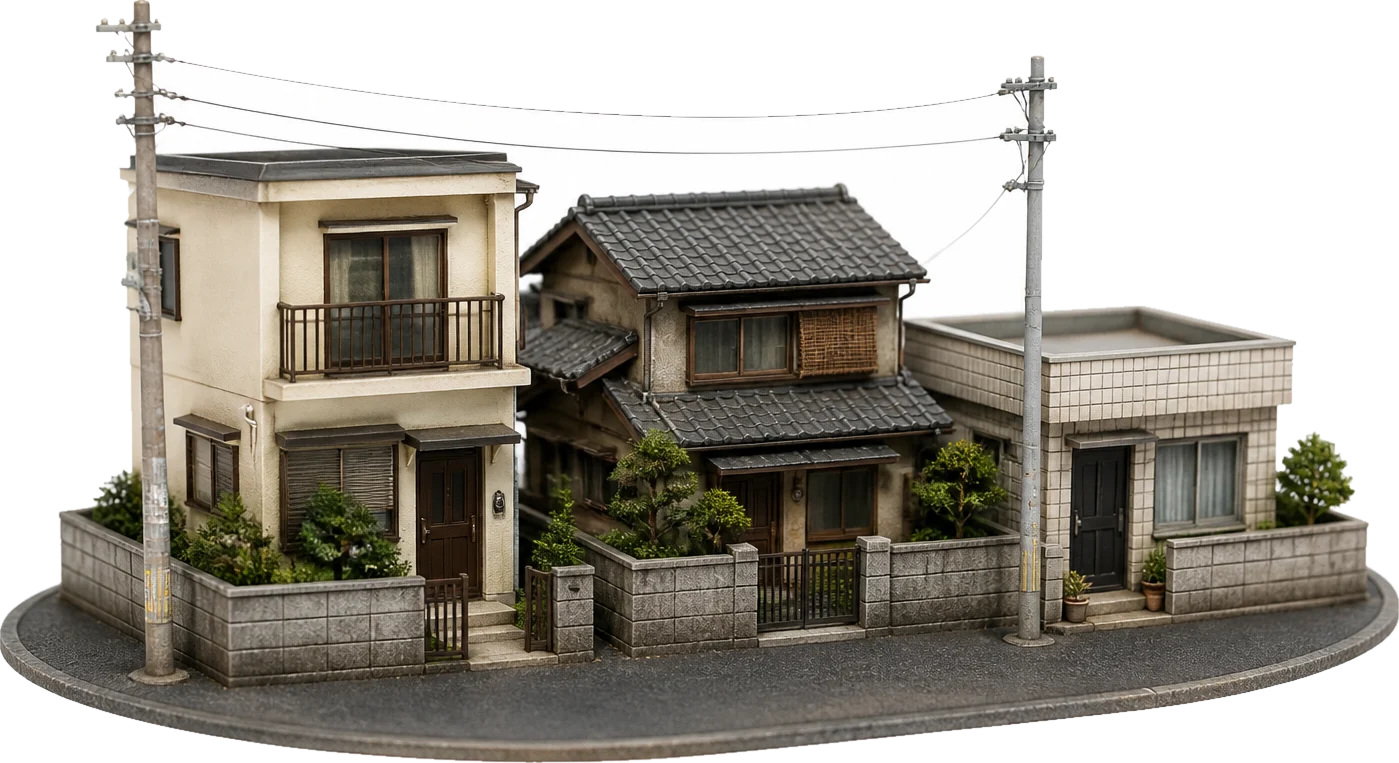
Five kinds of akiya, in the wild, in a single day.
Nobody learns anything from five versions of the same property. The route runs from a place that needs gutting to one you could sleep in that night, and from a farmhouse down a lane to a managed building with a lift, so you stop guessing from thumbnails and finally see what each kind of property is actually like. You get the real asking price at every stop, along with what the area gives you and what is nearby, the likely renovation scope and where the risk sits, and how that type holds up as a holiday place, a base, or something you rent out.
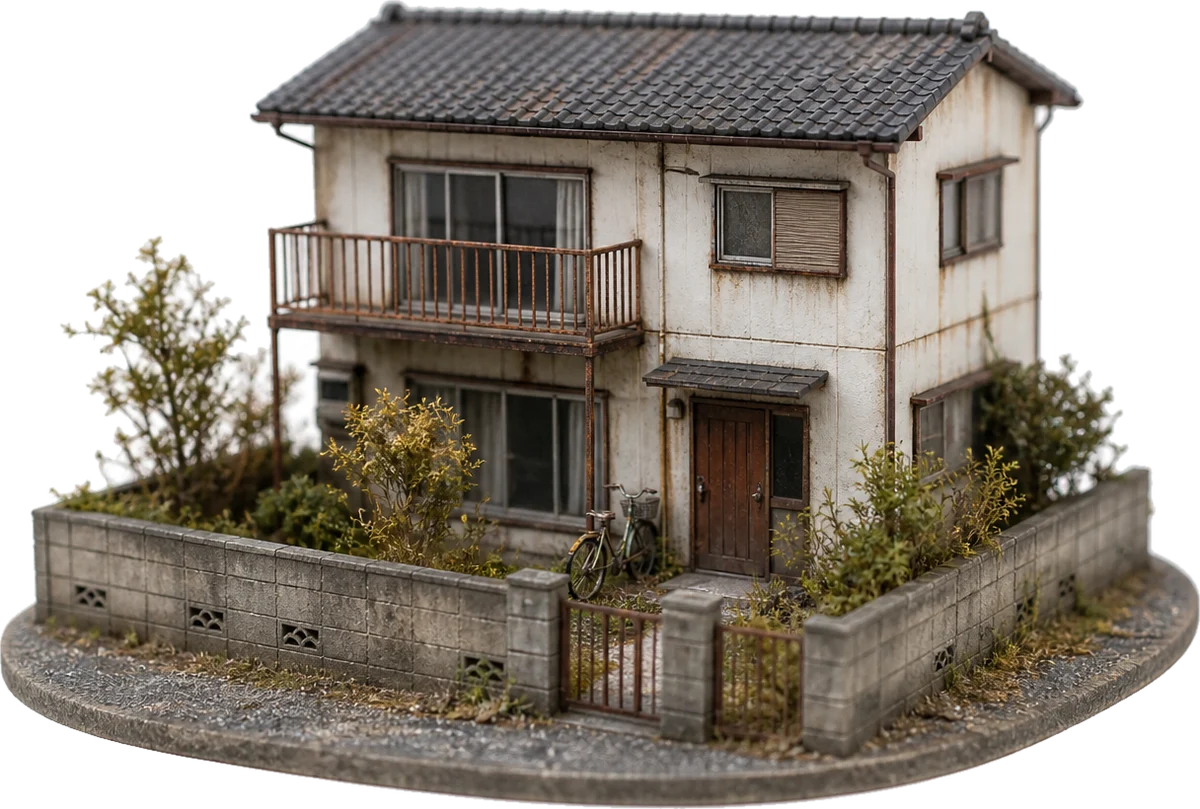
Cheap, or expensive in disguise?
The heavy renovation project
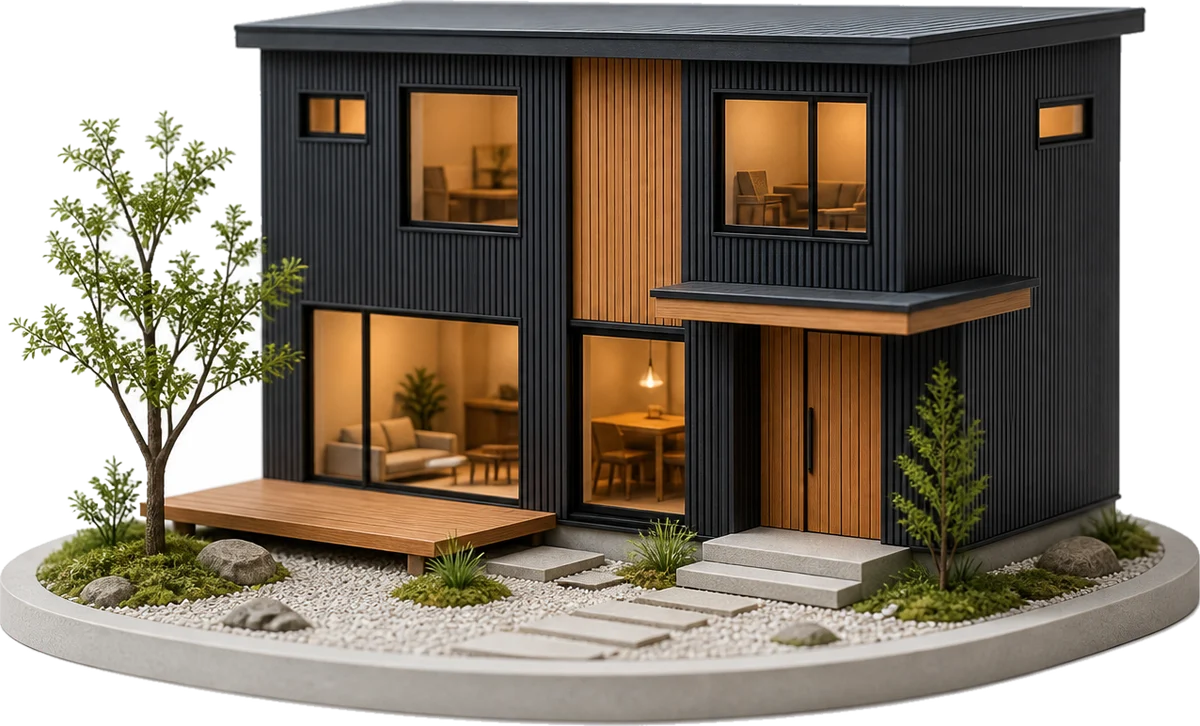
Tired paint, an overgrown garden, and a price that reads like a typo from outside Japan. This is the category everyone finds first online and nobody can judge from photographs. We walk you through what the renovation would actually involve, roughly what it costs, and where the risk sits, so you can tell the difference between cheap and expensive-in-disguise.
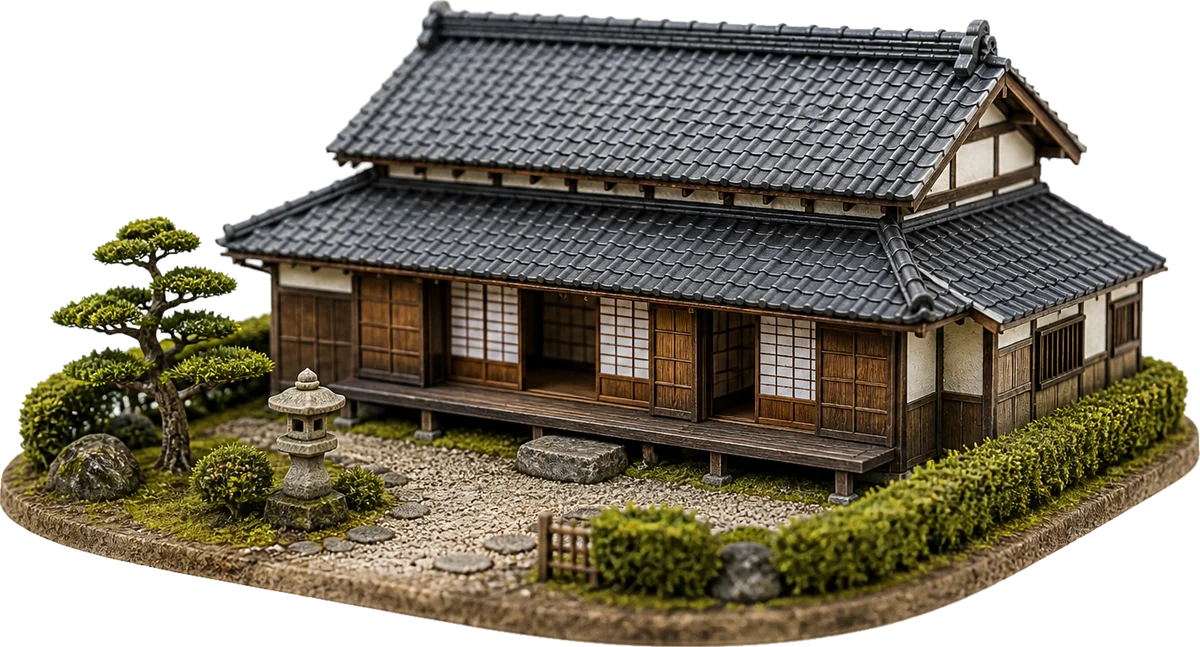
Holiday place, or somewhere you live?
The country house you pictured
Tile-clad, deep tiled eaves, a proper wooden entrance. This is the house people screenshot, and standing in one is a very different experience from looking at one. We cover what the area gives you, what is nearby and what is not, and whether this type works better as a holiday place or somewhere you actually live.
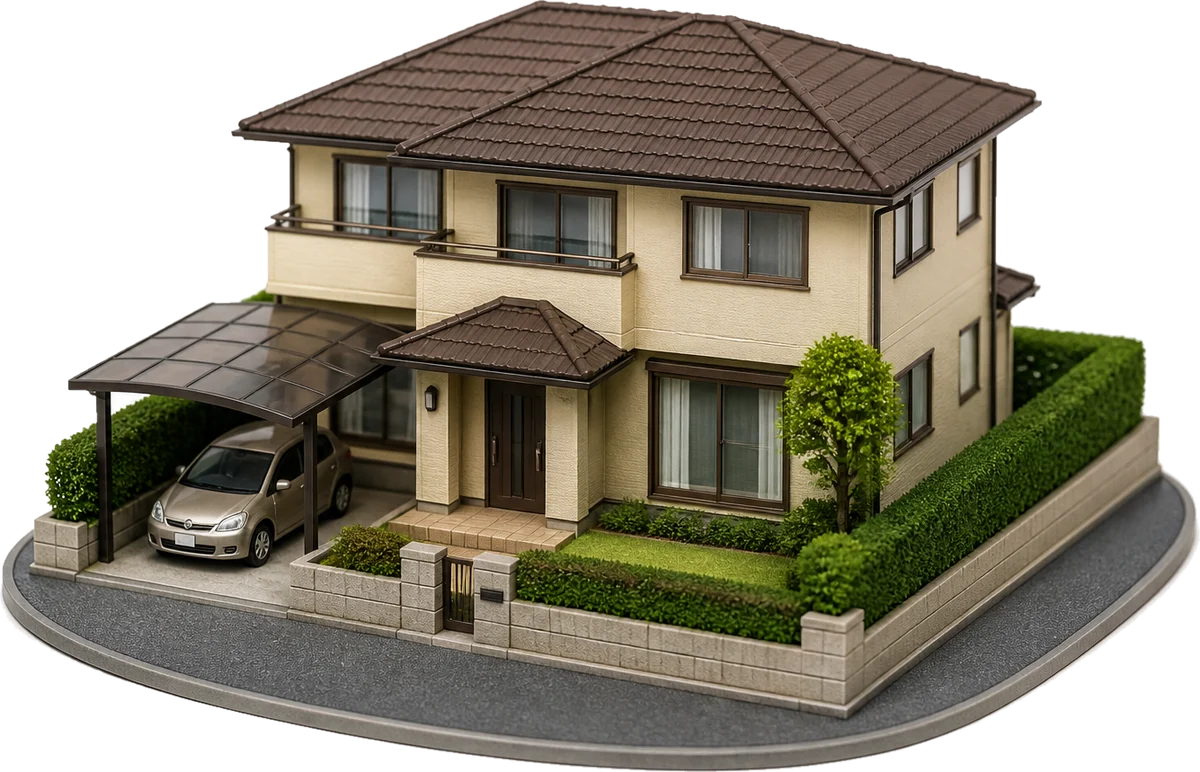
The one everybody scrolls past
The move-in-ready family home
A 1990s house with a carport, a gate, and nothing much wrong with it. Unfashionable, well built, and the type most foreign buyers scroll straight past. Seeing one properly is usually the moment somebody in the group revises their budget downward and their timeline forward.
Buy cheap and spend, or buy finished?
The newer detached house
Better street, room for two cars, and no renovation to plan for. This is where the group starts weighing whether it is smarter to buy cheap and spend, or buy finished and stop. Worth having that conversation out loud with people who have done both.
A completely different kind of ownership
The condo
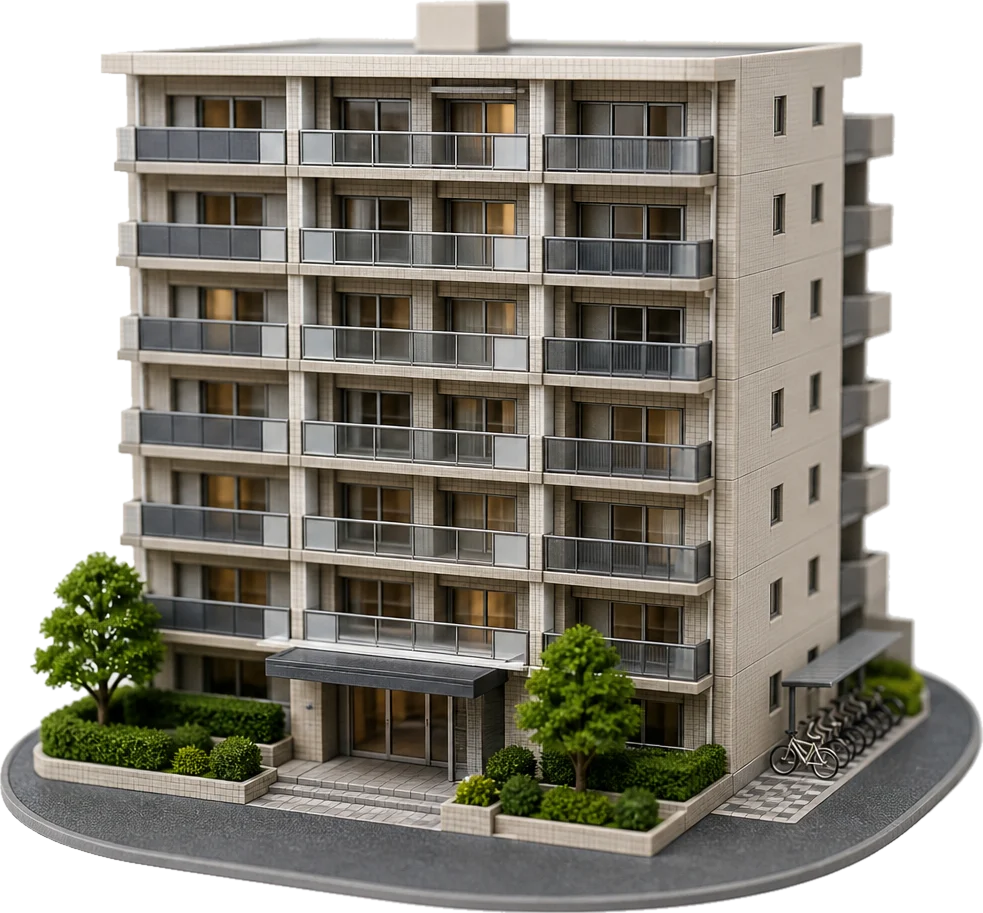
Lock up and leave, a management company handling the building, monthly fees instead of a roof to worry about. Completely different ownership experience from everything else on the route, and for a lot of people who arrive certain they want a house, it is the stop that changes their mind.
The point is to stress test your criteria.
Fall in love with one? Our team can help you pursue it through AkiyaHub.
It is built to show you the range, so you learn what genuinely exists at each price point instead of assembling a picture out of listing photos. And it is built to test the criteria you arrived with, because a brief written at a laptop in another country rarely survives an afternoon of standing in real rooms on real streets.
Almost nobody leaves with the brief they came in with. The cheap place turns out to be far bigger than it looked online. The big house turns out to carry more upkeep, more garden and more managing from abroad than anyone wants to sign up for. The condo nobody was considering starts to look like the sensible answer, or it goes the other way entirely and a house you would have scrolled straight past is the one you cannot stop thinking about. Working that out on the ground, in a day, is the whole exercise.
You get the full picture on every property, the problems stated as plainly as the appeal. If one fits, AkiyaHub helps you pursue it.
These are the five kinds of property on the route. Final homes and asking prices are set close to the date, and the numbers are in the Field Guide.
It is also the only day we are all in the same place.
You already know Shu Matsuo Post from YouTube. He hosts the Shu Matsuo Post channel, and he is also co-founder of AkiyaHub. On this day he is on the bus with you for the whole route, not delivering a keynote and disappearing.
You are also meeting the AkiyaHub Advisory Team, the people behind the scenes who make everything work. Every one of them has assisted in over a hundred deals themselves. They are the ones on the phone all day with agents and owners, the ones walking properties, evaluating what a listing will not tell you, running the video calls, and keeping the twenty parties in a typical purchase moving until the job is done. They built the relationships and the network that open five doors on one date, and they are the ones with the answers when the real questions start.
Most of what people actually want from us is not another document. It is twenty uninterrupted minutes with someone who has done this, answering your specific version of the question: your budget, your visa situation, your appetite for renovation, whether your family is really going to come. That is difficult to get over email and very easy to get while you are both standing in the room you are asking about. Treat the day as a full-day workshop that happens to take place on a bus and inside five properties. Bring everything you have been meaning to ask.
This group becomes a series.
Multiple episodes on YouTube, which is part of why we can open doors that are normally closed.
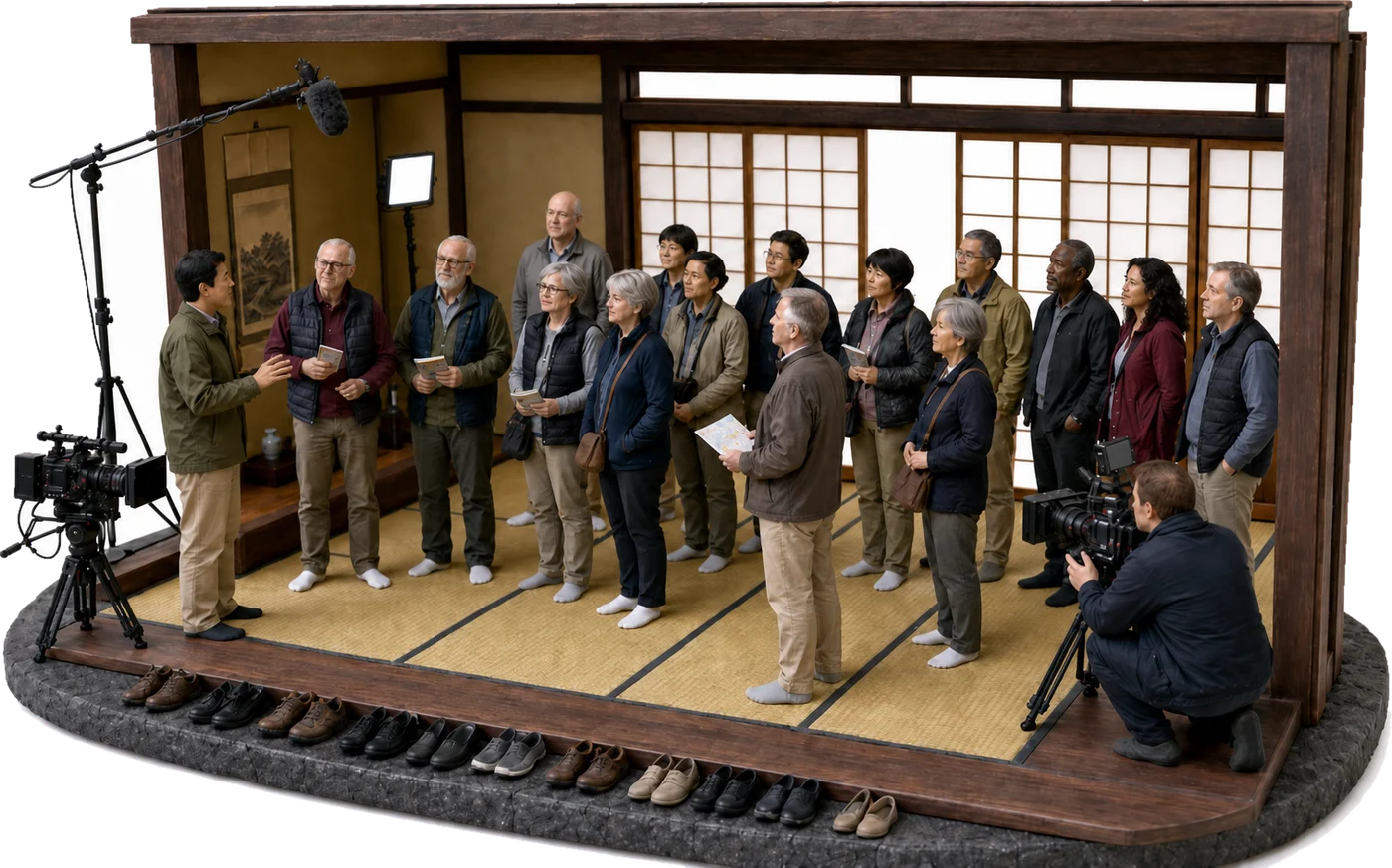
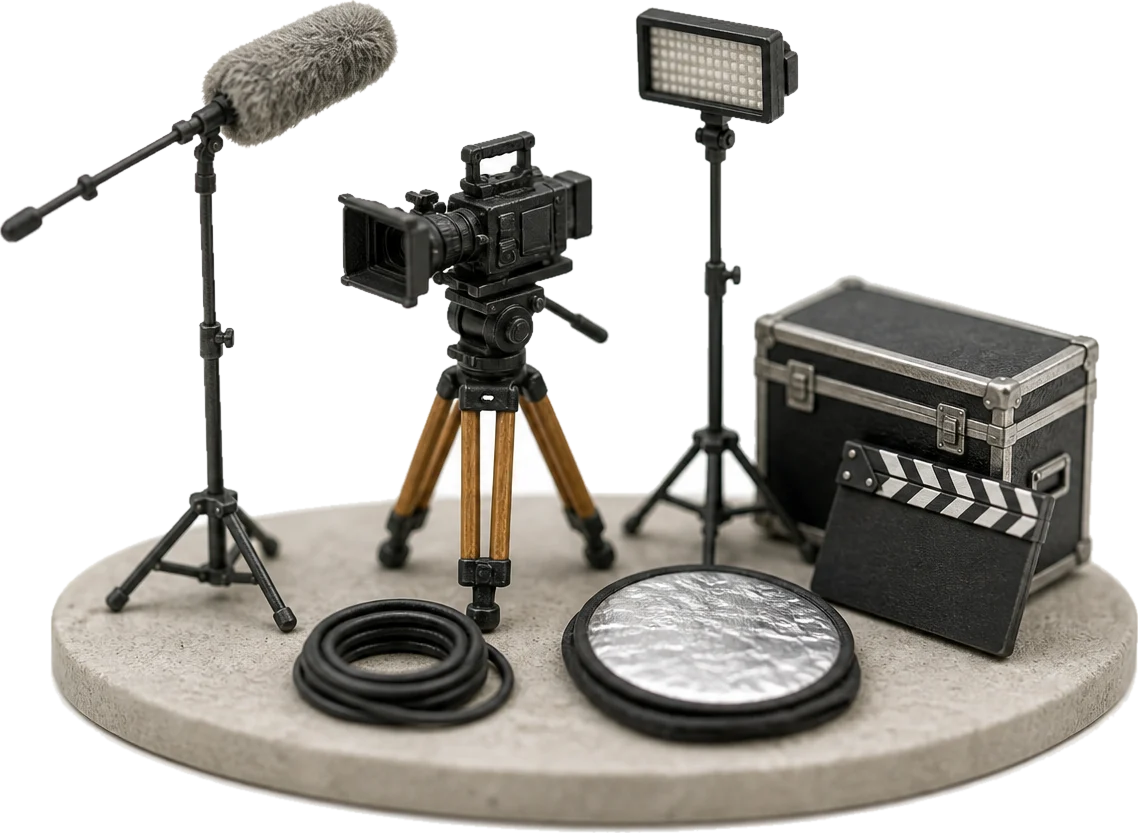
A professional crew films the whole day: the briefing, the drive, every walkthrough, the comparisons between stops, and the debrief over dinner. On-camera interviews run throughout, and they are not there for reaction shots.
The most valuable thing we can do with a day like this is record how people’s thinking actually changes. What you believed about your budget when you got on the bus in the morning, which house broke that assumption, and why. The moment the cheap place turns out to be far bigger than you had pictured. The moment the house you had saved for a year starts to look like more garden, more upkeep and more managing from abroad than you want to sign up for. The moment a condo you would never have clicked on becomes the sensible answer. That reasoning, said out loud while you are standing in the room, is the part nobody ever gets to see.
Cut together, it becomes a series on YouTube: multiple episodes following this group through the day and through every property on the route. There is no shortage of footage of Japanese houses. There is almost none of real buyers working out what they actually want while standing inside one. Thousands of people are stuck exactly where you are, guessing from listing photos, and what you work out on the ground is what helps them.
Which is why who is on the bus matters. We are looking for fifteen Akiya Hunters who are genuinely in this and who will say what they really think about a house while a camera is running. If you have ever quietly fancied being on a show, this is about as close as it gets.
The crew films the day for YouTube, and every attendee signs a participation release before booking confirmation. The ticket includes being on camera.
Everything that comes with the ticket.
The day itself is the visible part. A good amount of the value sits either side of it, in the preparation that makes the houses mean something and the follow-up that turns them into a plan.
The briefing call and your written brief
A private call before the trip, plus the written criteria document the team works against all day.
The chartered bus, Tokyo and back
One pickup point in Tokyo, the full loop, and the return that evening, with snacks and water on board all day. You organise nothing and you drive nothing.
Access to up to five properties, agreed in advance
Every stop is a property that is genuinely for sale, with access arranged with the agent and the owner ahead of the date. We arrange five and guarantee at least three.
A full day with Shu and the AkiyaHub Advisory Team
With you for the full day: the briefing, every walkthrough, the bus between stops, and dinner. Accessible, not ceremonial.
The printed Field Guide
Once the final stops are locked, every property on the route with its asking price, typical renovation ranges, and the pros and cons of each area. Room to take notes if you want to. It is not homework.
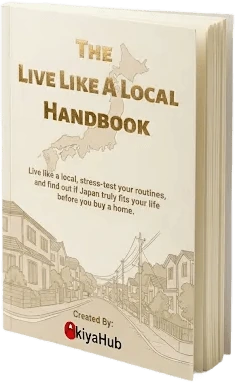
Live Like a Local, printed and bound
Your own physical copy of the 161-page handbook, printed and bound. More on it below, but it is yours to take home.
Dinner in Tokyo and the open Q&A
A proper meal back in the city once the driving is done, and an unhurried question session with the team and everyone else on the bus. Nothing is off the table.
A private follow-up call and written 90-day plan
Within a week of the trip, one to one, turning the day into something you can act on.
Twelve months of AkiyaHub membership
A new 12-month membership or a 12-month extension, so you keep learning, searching, and asking questions long after the bus gets back.
The one you take home
Live Like a Local, all 161 pages of it, printed for you.
This is the playbook we wish had existed when we first moved here, and it runs from the moment you land to the point where you are genuinely functional, about ninety days later. Everywhere else it is a digital download that sells for $197. Everyone on this bus gets a physical copy to take home.
It also carries the working parts: neighbourhood and area comparison scorecards, home evaluation sheets, weekly reflection templates, and checklists for your arrival, your first day and your first week.
Before you arrive
Visa reality checks, budget planning, choosing where to base yourself, work and internet prep, money and phone setup.
Your first 24 hours
Airport to front door, inspecting the place you have landed in, the first grocery run, orienting in the neighbourhood, and a jet lag plan.
Your first 7 days
Finding a weekly rhythm, transport basics, eating like a local, trash and building rules, and getting help without Japanese.
Weeks 2 to 12
Building routines that last, exploring beyond your own area, meeting people, and stress testing whether the daily life actually suits you.
What you leave with
Criteria revised against what you actually reacted to in real rooms
A written 90-day plan with the next three things you do
The printed Field Guide and the Live Like a Local handbook
A position you can defend on type, budget, and tradeoffs
From people who already bought with us
Every one of them was exactly where you are now.
Scroll for more
AN
Armando N.
International · Property
Other agents ghosted me - AkiyaHub delivered
“I had an outstanding experience working with Akiyahub on a recent real estate purchase in Japan. Before finding Akiyahub, I reached out to two other real estate agents and never heard back after the initial call, a stark contrast to the proactive and reliable support I received from the Akiyahub...”
“We recently purchased a home in Chiba through AkiyaHub. Our initial intent in purchasing a property in Japan was to be able to provide a base for family and friends to use in their visits to this vibrant and incredibly interesting country. We all look forward to creating many happy memories here.”
Two income properties closed, contributing to revitalization
“We recently closed on our first two properties in Japan and we absolutely couldn't have done it without the support and guidance of AkiyaHub. Navigating Japanese real estate as a foreign investor comes with its own set of challenges, including cash only transactions, language barriers, and complex...”
Member to homeowner in 4 weeks, now multiple properties
“Within 4 weeks of becoming a member, I closed on my first house. After closing, AkiyaHub helped me get connected with an insurance agent, a contractor, and a property manager. After closing my first and second properties, AkiyaHub sent staff members to meet me each time to hand over the keys and...”
US Real Estate Broker: Costs well worth it for remote buying
“If you're looking to purchase property in Japan and need someone to represent you due to a language barrier or lack of knowledge of how property transactions are in Japan, AkiyaHub is the way to go.”
$4,996 for the two of you. The add-on covers the second ticket, a second Field Guide and handbook, and a follow-up call you take together, on one shared 12-month AkiyaHub membership. Both of you count against the cap of fifteen Akiya Hunters.
If you decide you want us to run the search and coordinate the purchase for you, start Japan Akiya Assist within 30 days of the trip and 100% of your ticket is credited toward the program. In that case the day costs you nothing beyond what you were going to spend anyway, and you arrive at it already knowing exactly what you are looking for.
The credit exists because the day is the first step of the same search.
Selection first
Nobody is asked for money before they have a ticket. Full payment is then due inside a 72-hour hold.
Date confirmation
We set the day only after all fifteen tickets are confirmed. Hold 16 to 31 January 2027 and expect short notice. Applying means you can travel on any day inside that window.
Attendee cancellation
Fully refundable up to 60 days before the event. Inside 60 days it is non-refundable, including if the confirmed day turns out not to suit you, because the access and the crew are already booked. Tickets are not transferable.
If we cannot deliver
If AkiyaHub cannot run the minimum program, which includes dropping below three properties, you get a rescheduled date or a full refund of the ticket, your choice.
How to get a ticket.
Create your free account
Applications run through AkiyaHub, so create a free account and verify your email. Accepted hunters receive 12 months of membership with their ticket.
Apply
A short application: what you are looking for, the budget band you are working in, roughly when you expect to buy, and confirmation that you can hold 16 to 31 January 2027.
A 15-minute fit call
We read every application and get on a quick call. With only fifteen Akiya Hunters, who is on the bus matters as much as which properties are on the route.
Your ticket is confirmed
You get a 72-hour hold. Payment and the signed participation release complete the booking. You also complete Purchase Readiness before arrival.
Before you apply.
Could I not just arrange something like this myself?
Getting several viewings in different towns in one day, as a foreign buyer, takes owners, agents, a crew, and a route that all line up. That is what this day brings together.
Are you trying to sell me one of these houses?
The day shows you the range. If one of the five suits you, say so and we will help you pursue it through AkiyaHub.
Which properties will we see?
The exact homes are selected once we understand the confirmed group, then locked close to the date so the Field Guide can carry real asking prices. Every stop must still be actively for sale and accessible on the day. We arrange five deliberately different properties, with three as the minimum. These are live listings, so if one sells in the weeks before the date we replace it wherever we can. If we cannot deliver at least three, we reschedule or refund in full.
Could a property sell before the event?
Yes, and it happens. Live inventory moves quickly. AkiyaHub may replace a planned stop with another current property that preserves the intended contrast. The day is planned around five stops, with three as the minimum.
Do I have to be on camera?
Yes. The whole day is filmed for a multi-episode YouTube series, with on-camera interviews during the day. Every accepted attendee signs a formal participation release before booking confirmation. On a couple ticket, the primary applicant signs for both of you. The ticket includes being on camera.
How do people actually pay for these? Can I get a mortgage?
Plan on a cash purchase. Japanese mortgage lending is generally not available to buyers who do not live in Japan, so almost everyone in this price range buys outright, often funding it from savings or from borrowing against something they already own at home. On the day we cover how funds move, what the transfer looks like in practice, and the costs that sit on top of the purchase price.
Can a foreigner even own property here, and does it get me a visa?
Foreign buyers can generally own property in Japan without being residents, and you do not need a visa to buy. Owning a property does not itself grant a visa, residency, or the right to live in Japan, and anyone who tells you otherwise is selling something. Those are two separate questions and we will be straight with you about both.
Do I need an AkiyaHub account to apply?
Yes. Applications are handled inside AkiyaHub, so you create a free account and verify your email first, then the application opens. An accepted ticket includes 12 months of membership.
Do I need to be ready to buy immediately?
No. It is built for serious buyers planning a purchase within about 12 to 24 months, including people who need to stand inside a few houses before they can honestly set that timeline. It is not for casual curiosity with no purchase plan.
Is this a professional property inspection?
No. You will learn a practical buyer-level evaluation process and identify the questions that deserve deeper investigation. Structural, pest, moisture, electrical, plumbing, code, and other specialist checks still require the appropriate licensed professionals.
What food and transport are included?
The chartered bus from the designated Tokyo pickup point, the return to Tokyo, snacks and water on board throughout the day, and dinner back in Tokyo that evening. There is no lunch stop, because fitting five properties into one day means the bus has to keep moving, so eat a solid breakfast and bring anything else you know you will want. Lodging, flights, and your own travel to the pickup point are not included.
When exactly in January is it?
We set the date once all fifteen tickets are confirmed, because five owners, five agents, a film crew and fifteen people have to line up on one day. We are targeting 16 to 31 January 2027. Keep that period open. We tell you the fixed day in time to book flights. Every ticket holder is reviewed for the agents and owners on the route, so tickets stay with the named holder.
How physically demanding is the day?
Expect a full day of standing, walking, and stairs. Older Japanese houses often have steep staircases, and we move through five properties with limited downtime between stops. Tell us about mobility or health considerations on the application so we can plan around them where we can. January weather can be cold, so dress in layers and wear shoes you can walk in for hours.
Can I bring someone who is not buying?
The couple rate covers one buyer plus a partner or companion on a second ticket. Adult children, friends, or other guests who are not the second ticket holder are not included. Both people count against the cap of fifteen Akiya Hunters, and everyone on the bus has to be on the application.
I am already an AkiyaHub member. Does the included year stack or extend?
It extends. If you already have an active membership, your ticket includes a 12-month extension from your current expiry. If you do not, you get a new 12-month membership as part of the ticket.
Where does the footage appear, and can I change my mind later?
The day is edited into a multi-episode series published on YouTube. Before the booking is confirmed you sign a formal participation release in AkiyaHub that names everyone in your booking. Once that release is signed, consent for footage already captured stays in place for the series. This edition is filmed throughout, and the ticket includes public footage.
What language is the day conducted in?
English. The AkiyaHub Advisory Team handles Japanese with agents and owners as needed. You do not need Japanese for the day.
What should I bring and wear?
Comfortable walking shoes you can remove and put back on easily (many homes are entered in socks), layers for cold January weather, a small bag for the Field Guide and notes, and any snacks you know you will want beyond what is on the bus. We send a packing note once your ticket is confirmed.
What happens if the program cannot run as planned?
If AkiyaHub cannot deliver the minimum program, we will offer a rescheduled date or a full ticket refund. Attendee cancellations are refundable only when received at least 60 days before the event. Inside 60 days they are non-refundable, including when the confirmed date turns out not to suit you, because the access and the crew are already booked.
Fifteen Akiya Hunters. One private bus. A full day in the field.
Apply now. Accepted hunters receive 12 months of AkiyaHub membership with their ticket. Applications are reviewed as they arrive. Hold 16 to 31 January 2027. The day is confirmed once tickets are set, and payment follows your ticket.
If you have been waiting for a way to actually get inside these houses, this is it, and there is not a second one scheduled.