
Step 0 · How buying with AkiyaHub works

Before you start searching,learn how buyingactually works.

Most foreign buyers jump straight into listings and only later discover the hard part: 9 different people in Japan all have to say yes, in a process they have rarely done with someone overseas.

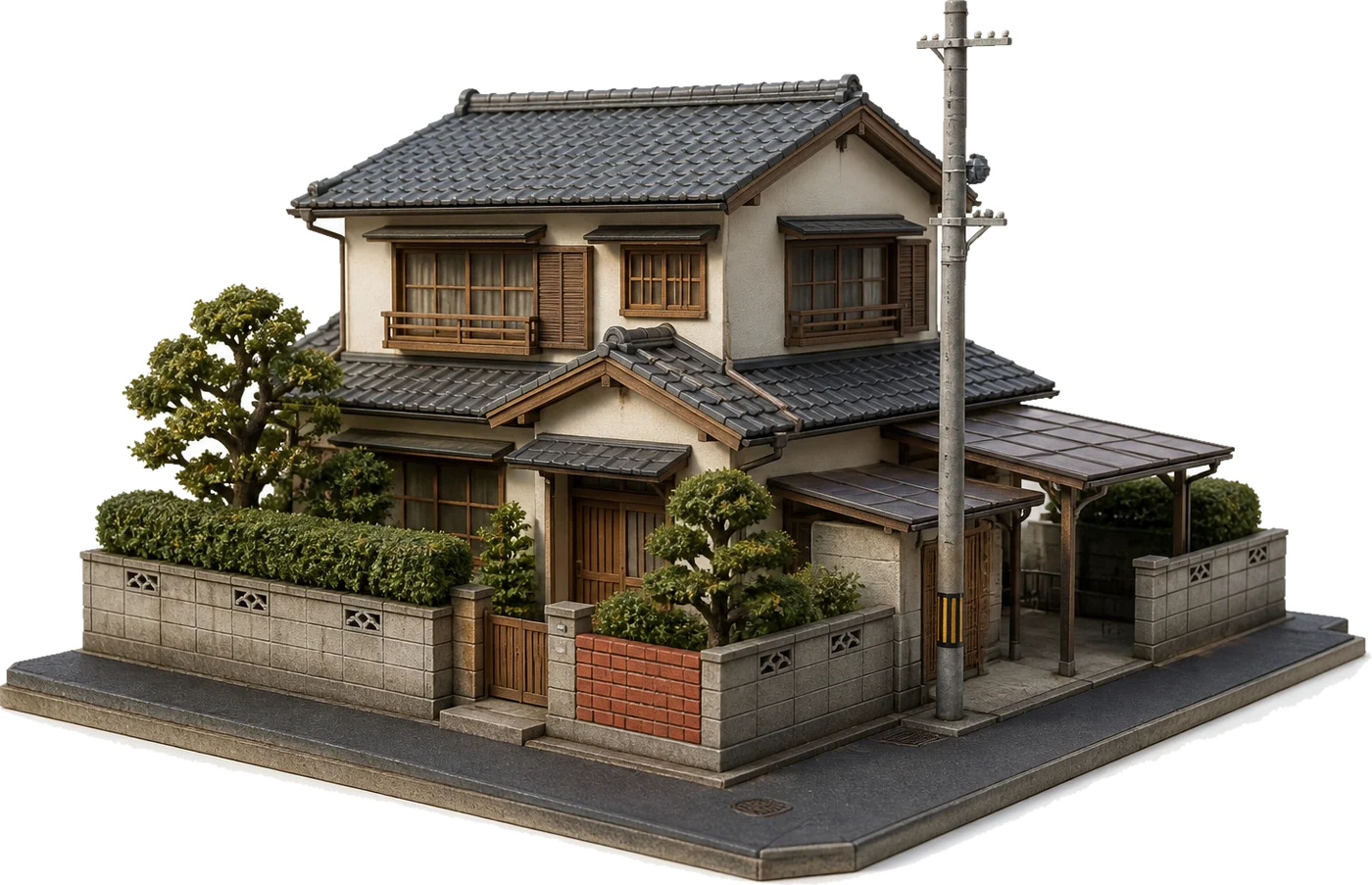
Miniature model of a Japanese residential street corner with a two-storey house, block wall and carport

This page is Step 0. In a few minutes you will see who is involved, who is responsible for each step, and how your money moves the whole time. So when you do start searching, you are not guessing. You are following a clear plan with one English-speaking team coordinating agents, scriveners, and banks for you, while a regulated Japanese trust company holds your purchase funds instead of an agent or seller.

01

1

English-speaking team.

Your local licensed agent may change from property to property. Your AkiyaHub team does not.

02

0

Yen we ever hold.

Purchase funds sit with a licensed Japanese trust company, not with us, your agent, or the seller.

03

0

Commission or kickbacks.

We earn from membership and fixed-price services, so what we make never depends on the price you pay.

04

47

Prefectures covered.

Licensed local professionals through 300+ vetted partners, nationwide.

Buyers who did this

Hundreds of foreign buyers followed this exact process and now own homes in Japan.

Every story below started the same way: living outside Japan, not reading Japanese, and unsure who to trust with a large international transfer. They ran the same process this page lays out, with one English-speaking team coordinating local licensed professionals and a regulated Japanese trust company holding the purchase funds, and they finished with keys in hand. These are their words, not ours.

★★★★★

Rated 4.8/5 by verified buyers

Real reviews from members who used AkiyaHub to navigate buying a home in Japan.

The problem

7 “wait... who's handling that?” moments in a Japan property deal.

These are the questions that quietly stop serious overseas buyers. In a normal deal, nobody gives you a straight answer and most of it falls back on you. With AkiyaHub, each one has a named professional and a clear process.

01

Who is actually my licensed agent?

In many deals from overseas, you never really know who is officially on your side. You always work with us. We go to the vetted buyer-side licensed Japanese brokerage that fits the property you selected. That may be more than one agent. You still only deal with AkiyaHub.

02

Who really checks the property?

Most foreign buyers are relying on the listing photos. Our team goes to the property, documents it on video, and researches ownership, risks, and neighborhood context before you commit.

03

Who makes sure I know what I am signing?

Standard contracts are in Japanese and often rushed. We prepare an English Companion Guide alongside the Japanese contract so you can read the deal before anyone signs.

04

Who makes sure the title ends up in my name?

If this step is sloppy, you can pay and still not be the legal owner. A government-licensed judicial scrivener verifies identity, runs the title checks, and registers the transfer into your name.

05

Where does my money actually sit before closing?

In many deals, your funds pass through an agent's or seller's account. With AkiyaHub, your purchase funds are held by a regulated Japanese trust company. AkiyaHub never holds or accesses your money.

06

What if I cannot be in Japan on contract day?

Most agents expect you to show up or improvise. We arrange an appointed signer, under a Power of Attorney written for that one transaction, who already knows Japanese real estate terms and does not sign until the papers match what you approved.

07

Who coordinates all of these people?

Without a coordinator, you become the project manager in a language you do not speak. AkiyaHub runs the timeline, keeps every party aligned, and updates you in English so the deal keeps moving without you chasing anyone.

2 search paths

You can do the searching.Or you can hand it to us.

This is the one real fork in the road, and it happens before you make an offer. From an accepted offer onward, both paths run through exactly the same process.

Miniature model of a desk with a laptop showing a map of Japan, a notebook, and a model Japanese house
Path 1

You do the searching

You already know the areas you want and roughly what you are looking for. You search at your own pace with our tools, and bring us the properties worth acting on. We verify each one and take over the moment you want to move.

Best forBuyers who know Japan, know their areas, and want to drive the search themselves.

  1. 1

    You Do the Searching

    Browse properties using our Map Search, Quick Search, or Property Feed. You can also find properties on external sites and share the links with us to add them to your list.

  2. 2

    Basic Inquiry

    We contact the listing agent as your bilingual coordinator to verify availability, confirm pricing, check seller openness to a foreign buyer, capture key property details, and help position you as serious.

  3. 3

    Comprehensive Report

    Detailed investigation covering ownership status, liens, legal concerns, hidden costs, neighborhood insights, and offer context with non-binding discussion points to consider with the seller's agent. Goes beyond the property itself into the surrounding area.

  4. 4

    Video Walkthrough

    Our team travels to the property for a detailed video walkthrough, capturing high-quality photos and video with expert commentary on condition and surroundings. A first-person perspective without travel.

  5. 5

    Offer Submission

    We engage the vetted buyer-side licensed Japanese brokerage that fits that property, who drafts your formal offer and required legal documents. AkiyaHub verifies supporting documents and coordinates bilingual communication between you, your buyer-side agent, and the seller's agent.

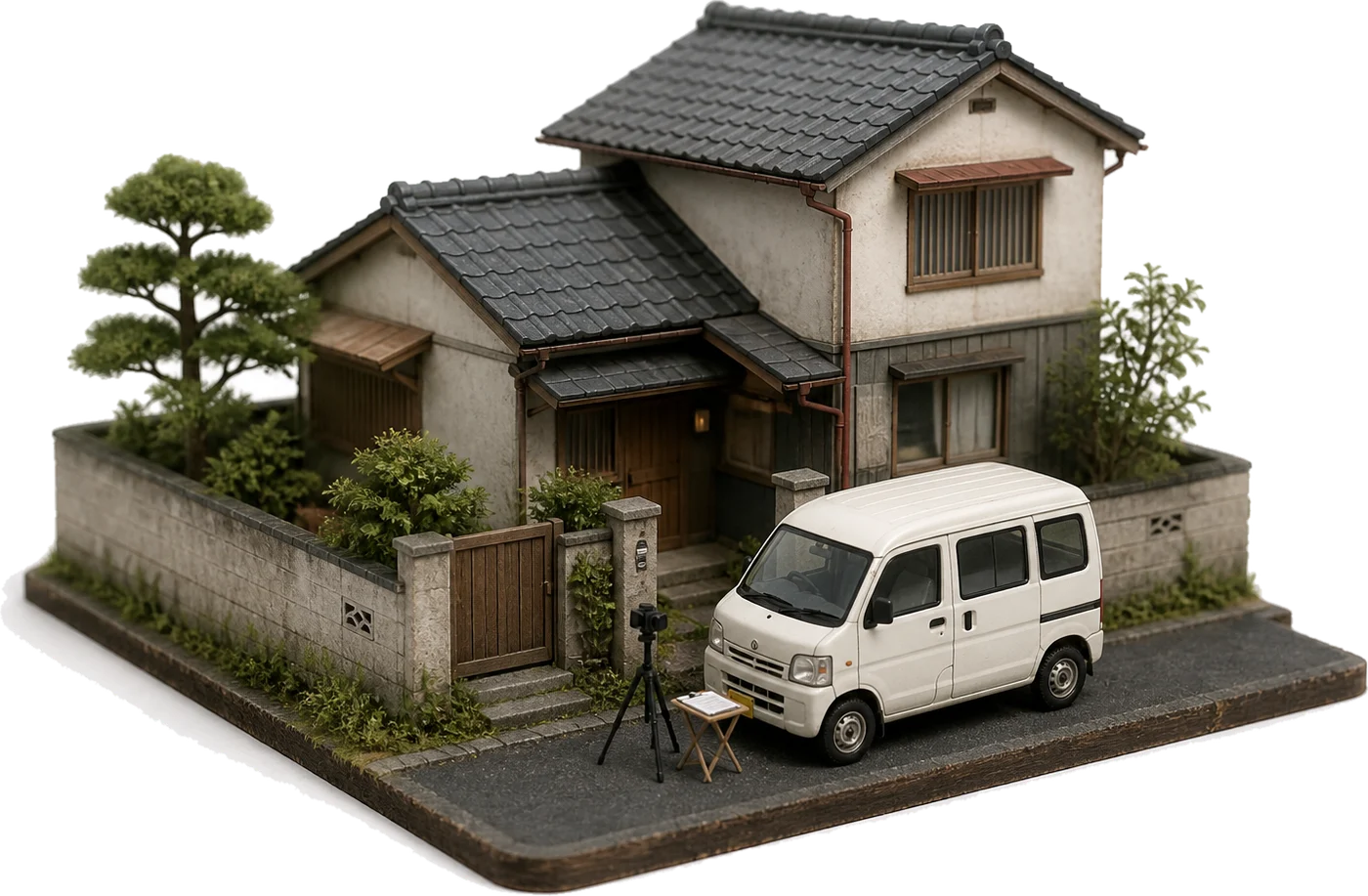
Miniature model of a small white van and camera tripod outside a Japanese house during a property visit
Path 2

Our team searches for you

You are not sure where to buy or what to look for, and you would rather not spend a year finding out. We onboard you, work out your real criteria, then search, vet, and present properties to you every week with strategy calls until you pick one.

Best forBuyers who want a team to define the brief, do the searching, and manage the whole purchase.

  1. 1

    Onboarding Call

    A detailed onboarding call to uncover your true criteria, assess what is and isn't realistic in the current market, and set the direction of search.

  2. 2

    Source & Vet 3/Week

    We source 3 properties per week matching your criteria and perform due diligence on top candidates.

  3. 3

    Review & Refine

    Meeting to review matches and refine criteria (Cycle repeats if needed).

  4. 4

    Viewing

    Remote video walkthrough (No in-person needed).

  5. 5

    Offer

    Formal Intent to Submit an Offer.

From the accepted offer, both paths are the same 12 steps.

Who does what

We do not replacethe licensed Japanese agent.We make the Japanese systemwork for you.

A Japanese property purchase always involves several regulated parties. The only question is whether you have to manage them yourself, in Japanese, from another time zone.

YouEverything in English
AkiyaHub

AkiyaHub

Your English-speaking advisory team

Your buyer-side agent

Vetted, licensed, and works on your behalf

Judicial scrivener

Verifies title and registers ownership

Escrow partner

Holds your funds in trust

Your appointed signer

Already read your contract. Will not sign if it has changed

The other side of the table

Seller's agentHolds the direct contract with the seller
SellerThe property owner
You do not have to navigate any of these parties in Japanese. We coordinate them for you.

Buyer (You)

The decision maker. You choose the property, the price, and the terms. Every other party works to your instructions.

AkiyaHub (Advisory Team)

Your English-speaking advisory team, and the only party you have to deal with. For each property, we go to the vetted buyer-side licensed Japanese brokerage that fits that house, then keep the licensed parties aligned through to the keys.

Seller Agent (Direct Source)

The agent who holds the direct contract with the seller. We locate and work specifically with them to avoid 'listing agent' middlemen chains and extra fees.

Judicial Scrivener

The legal safety net. A government-licensed professional who verifies identities and registers the official ownership transfer (deed).

Licensed Escrow Partner

A regulated Japanese trust company registered with the Kanto Local Finance Bureau since 2014. Holds purchase funds separately from AkiyaHub, the agent, and the seller, and releases them only on agreed conditions.

Your Appointed Signer

The party you appoint under a transaction-specific Power of Attorney. They already know Japanese real estate terms, have already reviewed your contract, and will not sign if anything has been added or taken out. Never the seller's agent.

Seller

The property owner. We manage this delicate relationship through the Seller Agent to ensure they feel comfortable selling to a foreign buyer.

Certified Japan Home Steward

A vetted local company, certified and audited by AkiyaHub, that checks the house on a schedule, handles the Japan-side bills and notices, and has the home ready before you arrive.

Insurance Provider

Provides Fire and Earthquake insurance. Critical asset protection immediately upon closing.

Every step

The 12 steps from accepted offerto the deed in your hands.

This is the same process map our members follow inside the platform, nothing held back until you pay. With the search phase in front of it, a full purchase runs to 17 steps. The 2 points where your money moves are marked in red.

Contract

7-10 Days
  1. 6

    Transfer EMD

    Your money moves here

    Transfer the Earnest Money Deposit to a licensed escrow account, not to AkiyaHub, not to the agent.

  2. 7

    Review Contract Docs

    You review the Purchase Agreement and the legally required Important Matters Explanation with an English Companion Guide alongside each Japanese original, prepared by our bilingual team for practical accuracy. A companion guide is not a certified or legal translation.

  3. 8

    Power of Attorney

    Sign a Power of Attorney written for this single transaction, so your appointed signer can attend the required appointments. They already know Japanese real estate terms, have already reviewed your contract, and will not sign if anything has been added or taken out. Most often that is an independent licensed brokerage, and it is never the agent representing the seller.

  4. 9

    Contract Day

    Your appointed signer attends having already reviewed your Japanese contract. If anything has been added or taken out, they do not sign until the papers match. AkiyaHub coordinates contract-day logistics, bilingual communication, document handoffs, and the required signing flow.

Miniature contract table with a sealed deposit envelope, matching contract folders, a property-specific Power of Attorney and a waiting name seal

Administration

3-5 Weeks
  1. 10

    ID Verification

    Video meeting with Judicial Scrivener (JS) for identity confirmation.

  2. 11

    Docs & Affidavit

    Documents prepared and mailed/emailed by Judicial Scrivener with our guidance. Complete and return with Notarized Affidavit.

  3. 12

    Insurance & Steward Intro

    Introduction to insurance partners and to a certified Japan Home Steward for the care of the house after closing.

  4. 13

    Remaining Balance

    Your money moves here

    Transfer remaining purchase balance.

Miniature preparation desk with identity documents, a notarized affidavit and a sealed yen balance envelope

Closing

  1. 14

    CLOSING

    Simultaneous settlement. The Judicial Scrivener confirms the transaction is valid and executes the official ownership transfer, escrow releases the funds, and your appointed signer attends having already reviewed the papers. They will not sign if anything has been added or taken out. AkiyaHub coordinates the day.

Miniature closing table with a sealed payment, a Japanese house, a title folder and house keys

Post Closing

  1. 15

    Keys & Steward Handover

    Handover of the keys and coordination with your certified Japan Home Steward so the house is looked after from day one.

  2. 16

    Renovation (Optional)

    Coordinate repairs yourself, or hand renovation project management to our team.

  3. 17

    Deed Delivery

    4-8 Weeks

    Official Title Deed mailed to you (4-8 weeks later).

Miniature Japanese house with a secure keybox, an optional renovation plan and a deed envelope awaiting delivery

What we actually do

The work that makesa remote purchase possible.

Most of it happens where you cannot see it: relationships with agents who have never sold to a foreigner, documents that only exist in Japanese, and timing that has to line up across time zones.

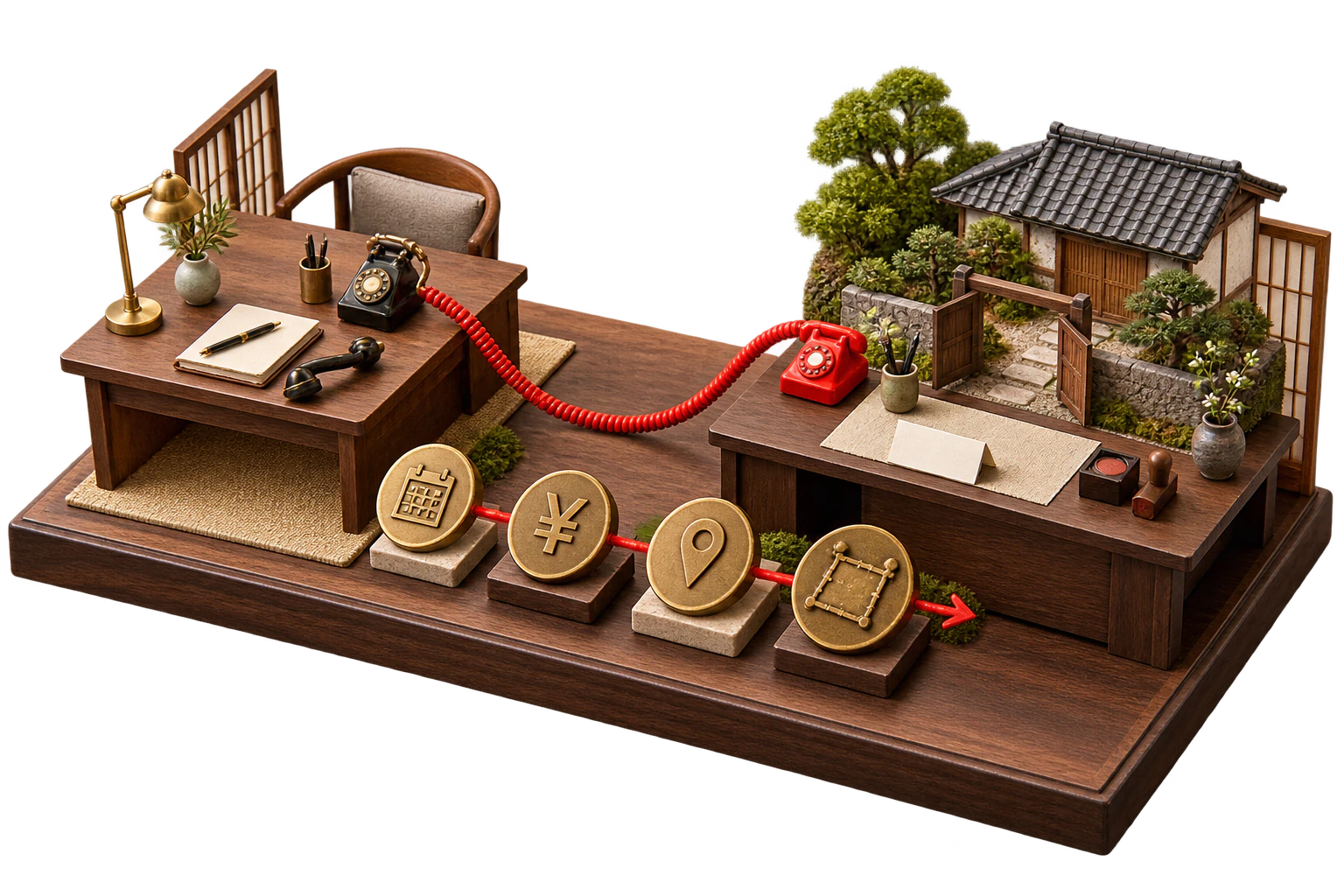
Miniature model of two property desks connected by a red telephone cord, with verification tokens between them

Before Offer

Basic Inquiry

The first filter, so you do not spend time or money on a dead listing or a seller who will not work with a foreign buyer. We contact the listing agent as your bilingual coordinator to confirm the basics, warm up the communication, and find out whether the seller and listing side are realistically open to proceeding with an overseas buyer.

  • Confirms availability, current price, ownership type, rebuildability, verified address, map details, and important agent notes when available.
  • Checks whether the seller and listing agent are open to a foreign buyer, which is one of the most common blockers in Japan.
  • Helps you avoid chasing properties that are already sold, materially changed, or unlikely to move forward.
  • Starts the relationship in Japanese so the listing agent sees you as a serious overseas buyer, not a cold inquiry.
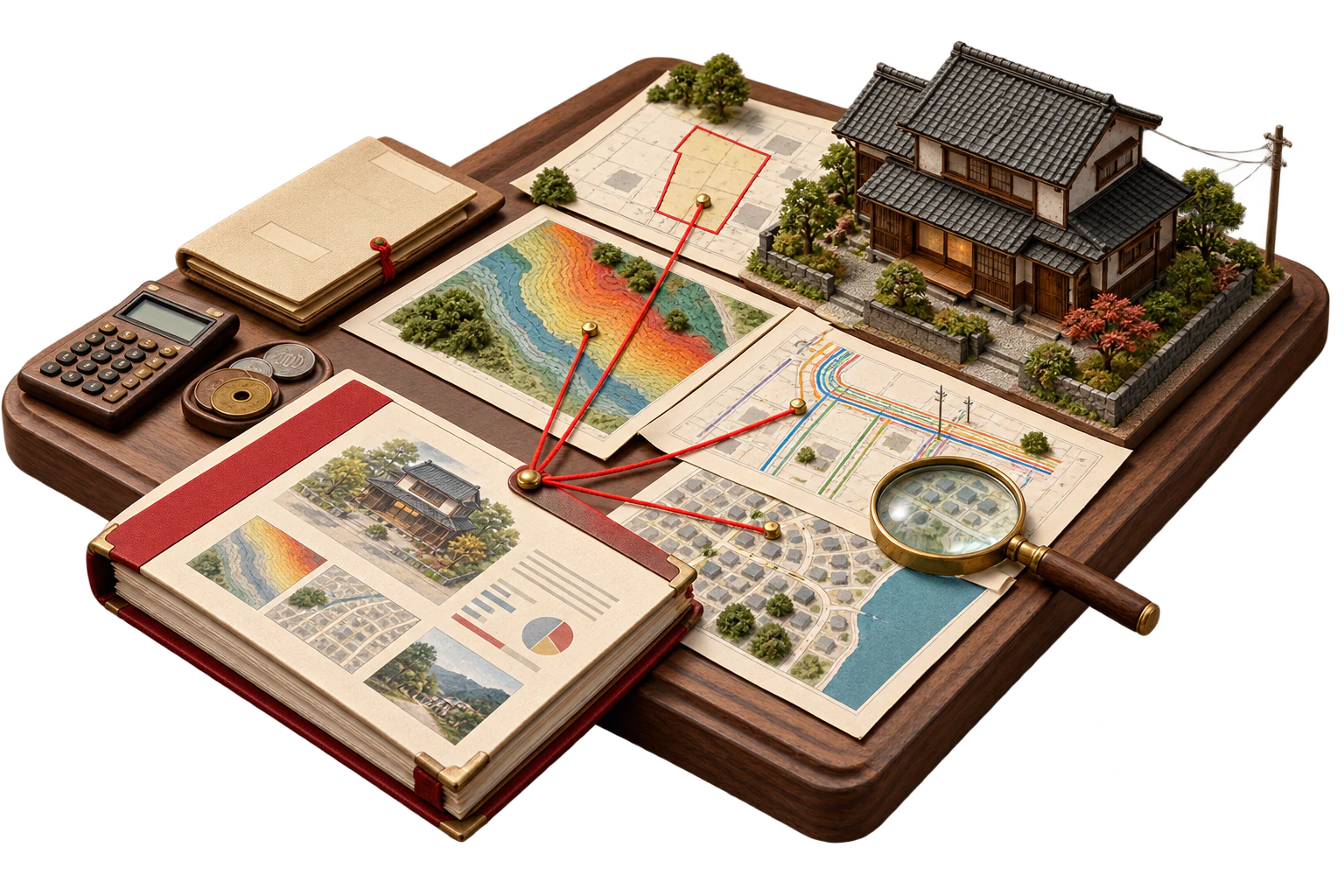
Miniature model of property, hazard, utility and neighborhood research converging into one bound report

Before Offer

Comprehensive Report

This is where we slow the process down before you speed it up. The Comprehensive Report is designed to help you understand what you are really looking at before you invest in viewings, offers, travel, or contract preparation. We pull together property, area, cost, risk, and pricing context so you can make a better next-step decision with fewer blind spots.

  • Reviews ownership status, potential liens, visible risk signals, hidden costs, utilities, land value context, hazards, and neighborhood factors.
  • Surfaces questions to raise before an offer, including non-binding offer context and discussion points for the seller-side agent.
  • Helps separate promising opportunities from properties that may be cheap for a reason.

Verified pre-contract research based on information available from multiple parties at the time. Not a legally binding disclosure and not a home inspection.

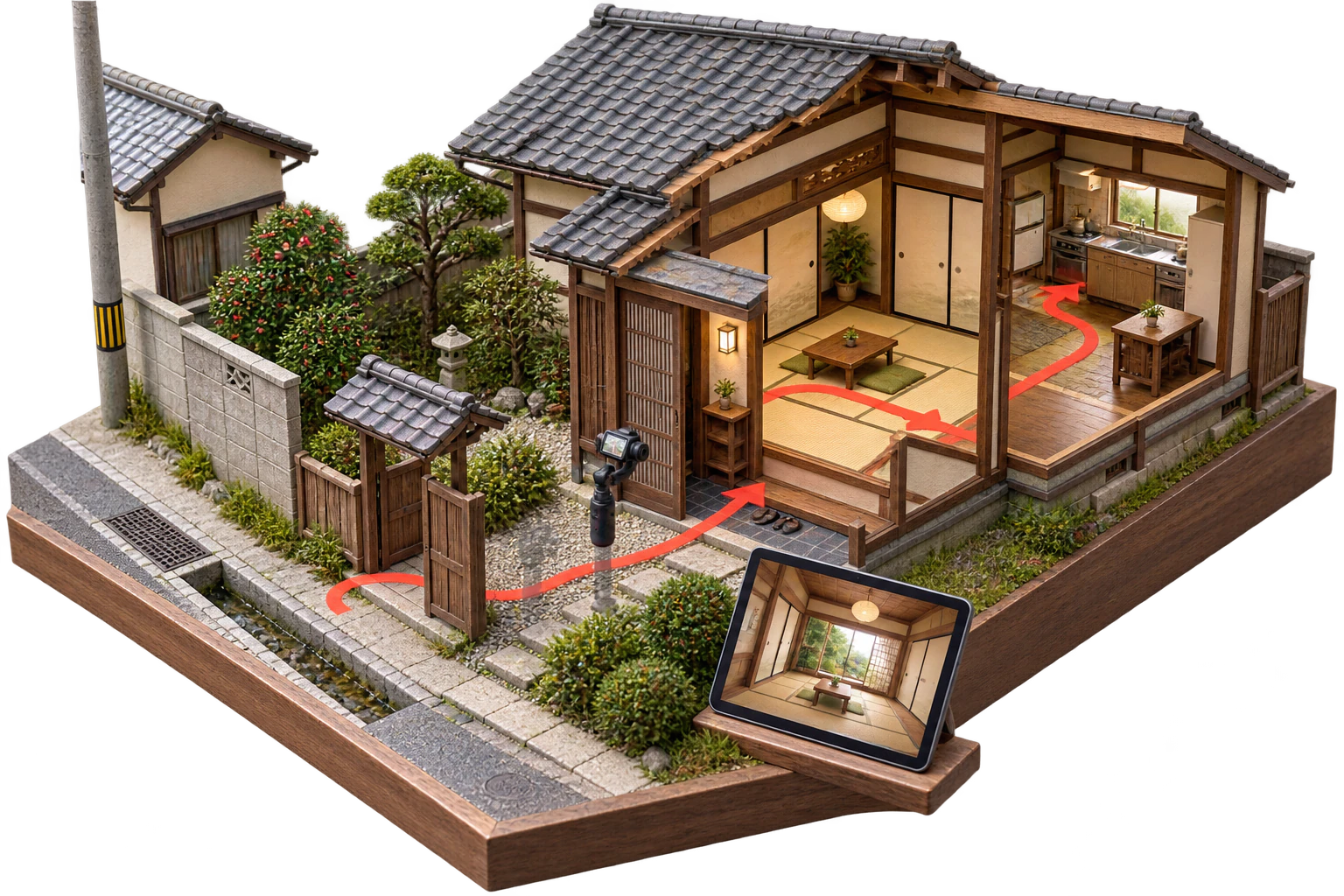
Miniature cutaway Japanese house with a camera following a marked route from the street through the interior

Before Offer

Viewing

Photos on Japanese listing sites rarely tell the whole story. A viewing gives you a practical, first-person look at the property and surroundings before you decide whether to keep moving. For many overseas buyers, remote viewing is the best way to evaluate multiple homes without traveling too early. Most of our buyers never set foot in Japan until after closing.

  • Includes detailed video, photos, neighborhood context, access notes, and practical observations from the visit.
  • Helps you catch obvious concerns, layout surprises, access issues, surrounding conditions, or reasons to investigate further.
  • Remote viewing lets you compare properties quickly while saving travel for the homes that truly deserve it.

A visual documentation service, not a home inspection. We do not diagnose structural, termite, moisture, electrical, plumbing, or code issues.

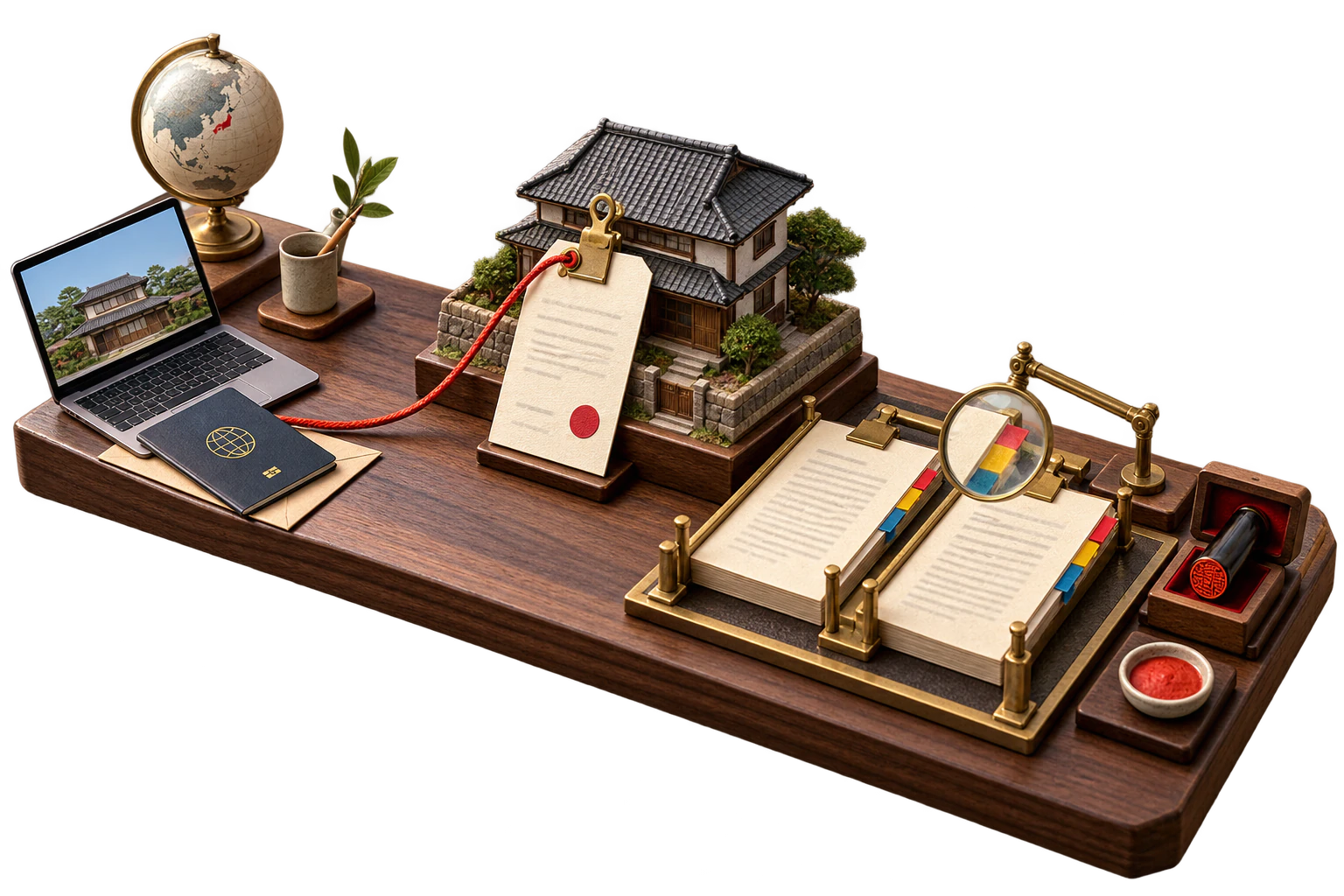
Miniature model of buyer materials moving through a licensed brokerage desk to the seller side on a document rail

Before Offer

Offer Submission

Once you decide to move forward, the offer is prepared by the vetted buyer-side licensed Japanese brokerage that fits that property. AkiyaHub organizes the supporting materials, verifies the required buyer documents, and coordinates bilingual communication so the offer can move cleanly through the right parties.

  • The vetted buyer-side licensed Japanese brokerage that fits that property prepares the formal offer and required legal documents.
  • AkiyaHub coordinates English and Japanese communication between you, your buyer-side agent, and the seller's agent.
  • Helps you keep momentum after you decide to offer, while final price and terms remain your decision and the seller's.
Miniature model of a property-specific Power of Attorney connecting a remote buyer to two matching contract packets and a waiting name seal

Contract

Contract Day

Contract Day can feel intimidating because the documents, explanations, stamps, timing, and parties involved are all operating in Japanese. If you cannot be there, your appointed signer attends under a Power of Attorney written for this transaction. They already know Japanese real estate terms, have already reviewed your contract, and will not sign if anything has been added or taken out. Our role is to keep the process clear, organized, and coordinated with the licensed professionals involved.

  • Appoints your signer for contract-day attendance when you cannot be there. They already know Japanese real estate terms, have already reviewed your contract, and will not sign if anything has been added or taken out.
  • Coordinates bilingual communication, scheduling, document handoffs, stamps, signing flow, and remote or in-person logistics.
  • Works around the licensed real estate professionals and judicial scrivener so each party has what they need.
  • Helps you move through the contract appointment with less confusion and fewer last-minute surprises.
Miniature mechanical closing table aligning escrow funds, registration papers, buyer identity documents and house keys

Closing

Closing Day

Closing is the final handoff, where funds, registration, ownership transfer, keys, and post-closing logistics all need to line up. If you cannot be there, your appointed signer attends under the Power of Attorney. They have already reviewed the papers for that day, and they will not sign if anything has been added or taken out. We coordinate the moving pieces with the judicial scrivener and the other parties so the day is organized and communication stays clear.

  • Your appointed signer attends closing when you cannot be there. They have already reviewed the papers, and they will not sign if anything has been added or taken out.
  • Coordinates closing-day communication, final document logistics, ownership transfer handoffs, and key handover.
  • Supports remote or in-person closing logistics with the judicial scrivener and local parties.
  • Connects the purchase to what comes next, including deed delivery, a certified Japan Home Steward, and ongoing ownership setup.

Where your money goes

Your purchase money never touches AkiyaHub.

Buying from overseas should not mean wiring millions of yen to someone you have never met and hoping. So we add a layer most transactions do not have.

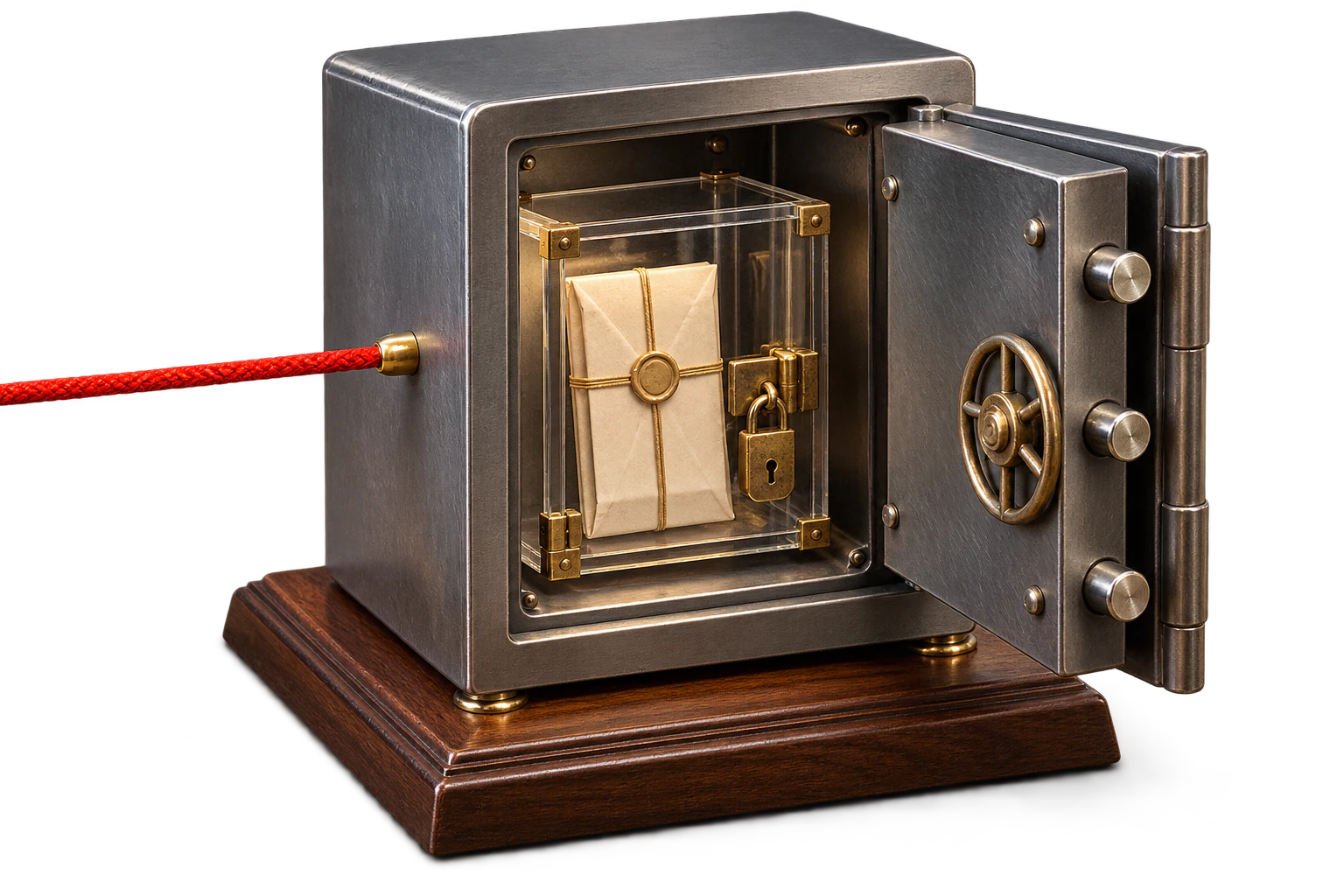
Miniature trust safe holding a sealed yen packet inside a separate locked compartment, beyond AkiyaHub's red coordination cord

Purchase funds are held by our licensed escrow partner, a regulated Japanese trust company registered with the Kanto Local Finance Bureau since 2014.

A trust company is not a normal business bank account. Trust businesses are licensed and supervised by government authorities, and they are required to keep client funds separate from their own and release them only under clearly defined conditions. AkiyaHub does not hold your purchase funds and does not have access to them.

  • Kept separate from company funds
  • Released only on agreed conditions
  • Protected if something goes wrong elsewhere

How the money moves

01

Contract Day deposit

After your offer is accepted you transfer the Earnest Money Deposit, usually 10% of the accepted price, to the licensed escrow partner. It does not go to AkiyaHub and it does not go to the agent.

In Japan this deposit is typically released to the seller on Contract Day once the contract is finalized. That differs from countries where earnest money sits in escrow until closing, and we would rather you hear it from us first.

02

Before Closing Day

The remaining balance goes to the escrow partner in advance, because international transfers take time and the funds must be in JPY inside Japan before the closing appointment.

That balance usually covers the remaining property payment, prorated property taxes, broker fees, judicial scrivener fees, and registration taxes.

03

Closing Day, simultaneous settlement

The judicial scrivener confirms the transaction is valid, ownership transfer is initiated and legally recorded, and only then does escrow release funds to the seller and the other parties.

The final payment is never released early. Money and ownership move together. In Japanese this moment is called 決済, kessai.

What escrow costs

Two handling fees of JPY 22,000 each, one for the deposit transfer and one for the final payment. JPY 44,000 in total, set by the licensed escrow partner. It covers secure handling of funds, verification steps, and coordinated release on closing day.

Japan is already safe. We add one more layer.

Japan has a well established closing system: a legally required Important Matters Explanation before you sign, judicial scrivener verification of ownership and identity, and simultaneous settlement so money and ownership move together. We are not telling you the standard process is unsafe. We are saying an overseas buyer deserves independent custody on top of it.

Ask anyone, not just us

6 questions to askbefore you send a single yen.

Ask these of us, and ask them of every other agent or platform you talk to. The answers tell you more about who you are dealing with than any brochure will.

Q01

Who actually holds my money between contract and closing?

Get a name and a role, not a reassurance. The honest answers are a licensed trust company, the brokerage’s own account, or a personal account. Only one of those is custody.

Q02

Are they licensed to hold client money in Japan, and under which license?

Holding client money in trust is a regulated activity in Japan. A company doing it properly is registered as a trust business with a Local Finance Bureau, and custody-only work sits under a 管理型信託業 registration. Our escrow partner is registered with the Kanto Local Finance Bureau and has been since 2014.

Q03

Can I verify that license myself?

Yes, and you should. Japan’s Financial Services Agency publishes the full public list of licensed and registered trust companies. If a company says it holds your money in trust and is not on that list, that is your answer.

Q04

Whose name is on the account, and who can move the money?

Client funds at a trust company are kept separate from the company’s own money and can only be released on the conditions agreed in advance. Ask whether one party can move your funds alone. With a trust structure, nobody can.

Q05

What exactly has to be true before the money is released?

You want conditions, not goodwill. In our structure the final payment is released at simultaneous settlement, once the judicial scrivener has confirmed the closing conditions and ownership transfer is underway.

Q06

What happens to my money if the deal collapses?

The answer depends on your contract, and you should read that clause before you sign rather than after. This is also the question with the most expensive wrong answer, which is why it gets its own section below.

The part nobody discloses

Late money does not just cost you the deposit.

Most overseas buyers assume the worst case is losing their earnest money. That is only the first stage. Japanese purchase contracts have two of them.

Before the cancellation deadline set in your contract, walking away generally costs you the deposit, typically 5 to 10 percent of the price.

After that date, or once either side has begun performance, a failure to complete falls under the contract’s penalty clause. That is commonly 10 to 20 percent of the purchase price, and it is capped at 20 percent when the seller is a licensed real estate business. The deposit is normally credited toward the penalty rather than being separate from it, so a 20 percent penalty against a 10 percent deposit means losing the deposit and owing a further 10 percent. Settling late can also trigger late-payment damages on top.

The most common way a foreign buyer stumbles into that second stage is money arriving late.

International transfers take days, Japanese banks settle on weekdays only, and a large transfer can be held while your own bank asks questions. That is the practical reason funds go early to a licensed Japanese trust account rather than being wired at the last moment: so the money is already in the country, in yen, verified, and ready to release on the day.

Percentages above reflect common market practice, not a rule that applies to every deal. Your actual exposure is whatever your signed contract says. AkiyaHub is not a law firm and this is not legal advice, which is exactly why we walk you through these clauses in English before you sign anything.

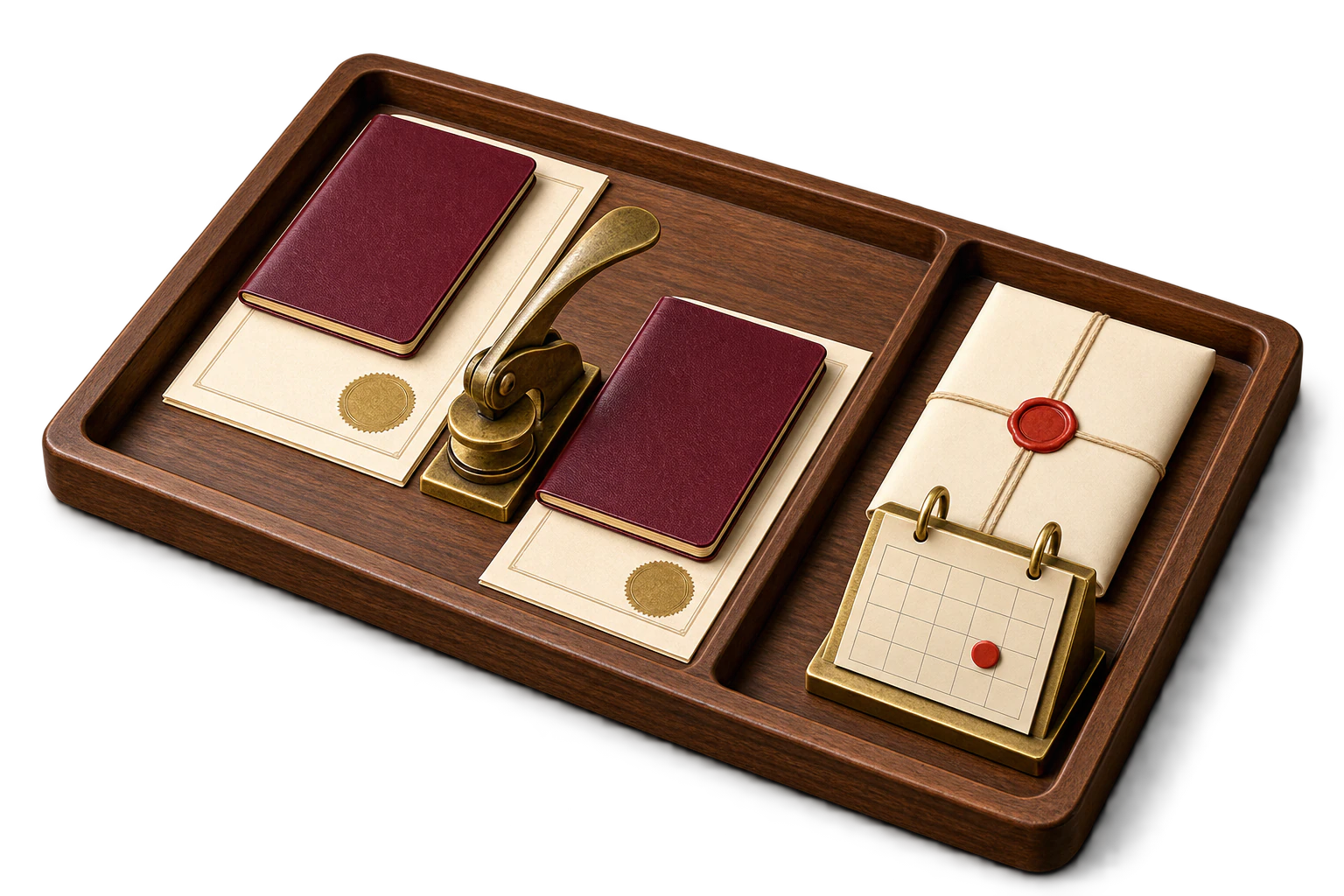
Miniature transfer envelope approaching a red closing deadline on a brass calendar from overseas
Miniature property-specific Power of Attorney connecting a remote buyer to an independent appointed signer, separate from the seller side

Who signs when you are not there

Your Power of Attorneyshould not be a favour from a friend.

When a seller or broker requires a signer to be physically present and you are on the other side of the world, someone has to sign in your place. Who that someone is matters more than most buyers realise, and it should never be a friend doing you a favour.

Your signer is appointed for one specific transaction under a Power of Attorney written for it, and you know who it is before you sign. Most often we appoint an independent licensed brokerage, deliberately separate from the agent selling you the house. Sometimes it is your own buyer-side agent, where they are one of our trusted partners. Occasionally it is us.

They already know Japanese real estate terms. They have already read your contract. They will not sign if it has changed.

  • It is never the agent representing the seller. The person signing for you is never on the other side of the table.
  • The POA is written for a single transaction. It is not general authority over your affairs.
  • They review your Japanese contract before the appointment, so they know exactly what should be on the table.
  • If anything has been added, taken out, or changed, they stop. They do not sign until the papers match.
  • They do not negotiate terms and do not give legal advice. Their job is to verify the papers, then sign.

Acting as your appointed signer is not in itself a licensed activity in Japan. We normally appoint a licensed brokerage anyway, because it is what the other side expects and it keeps the role at arm’s length from the sale. Attendance is charged as its own line in your cost breakdown rather than buried inside a service fee.

The part people underestimate

Notarized in person.In yen. On the right day.

Two things catch overseas buyers out more than anything else: who goes on the deed and what each of those people has to produce, and how a large sum of foreign currency reaches Japan on the exact day it is needed. Neither is difficult once you know. Both are expensive to discover late.

Miniature divided preparation desk with complete owner document kits, a notary press, a yen packet and a closing deadline

Every name on the deed multiplies the paperwork

Each title holder needs their own complete set of documents: a notarized affidavit, a passport, a second photo ID, and proof of address. Adding your spouse to the deed does not add one form, it adds a full set.

  • Online and remote notarization is not accepted. It has to be done in person.
  • The name on the affidavit must match your passport character for character, including a spelled-out middle name.
  • Keep the original notarized affidavit. It is needed at closing.

Getting the money there is its own project

This is the part buyers consistently underestimate. It is not a single wire. It is a sequence with hard deadlines, and the exchange rate is a real decision on a purchase this size.

  • Funds must arrive in JPY, inside Japan, before closing day. Japanese banks settle on weekdays only.
  • Large international transfers can trigger documentation requests from your own bank, so they have to start early.
  • Wise is a delivery rail, not an escrow service. It moves your money to the licensed escrow partner.
  • You do not need a Japanese bank account to complete a purchase.

After the keys

Closing is not the finish line.It is the start of owning a house in a country you do not live in.

The deed arrives 4 to 8 weeks later. Meanwhile the bills, the notices, and the building itself carry on without you. Most buyers only discover this part after they own it.

Miniature Japanese house with a secure keybox, arriving bills and a deed envelope awaiting delivery

Japan Home Stewardship

Your home in Japan needs someone in Japan.

A property manager is hired to run a building for profit: place tenants, collect rent, keep a unit earning. That is a real job, and it is not the job your home needs. So we built a stewardship program instead.

A certified Japan Home Steward is a vetted local company entrusted with your house and answerable to you. AkiyaHub designs the program, sets the national standard, and certifies and audits the Steward who delivers it. We do not manage your home ourselves, which means the same checklists and the same standard apply wherever in Japan you buy.

Bright aired-out Japanese interior after a property check01

Keep the house checked

Scheduled visits against a fixed checklist: ventilation, running the water, pests, damp, the exterior and the garden, storm damage, and anything the neighbours would notice. You get a written report and a video walkthrough.

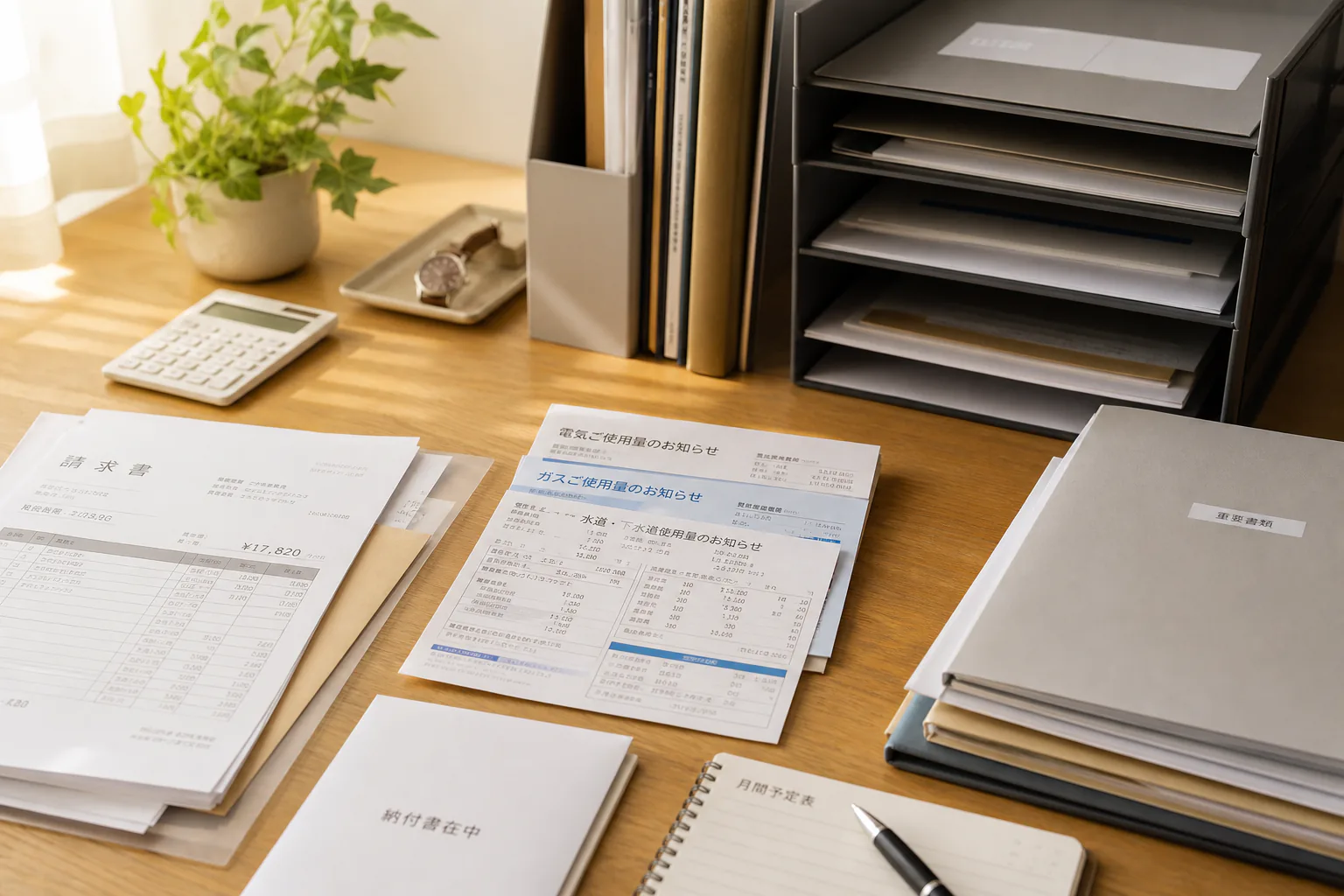
Organized desk with Japanese property documents and bills02

Keep the bills and admin organized

Utilities, property taxes, building fees, and the Japanese-language notices that arrive at the house. Your Steward handles the Japan side and explains it to you in English.

Warm arrival-ready Japanese vacation home interior03

Keep the home ready to use

Arrival preparation, cleaning, deliveries and setup, and coordinating contractors when something needs fixing. You land and the house is ready rather than stale.

Property costs run through an owner-funded expense advance with an itemized ledger per property: opening balance, every payment and receipt, and the remaining balance. Beyond a small emergency limit you set yourself, nothing is paid without your written approval. That advance is not a deposit account, an escrow account, or a bank account, and it is entirely separate from the purchase escrow described above.

How we are paid

2 things we do not do.

Everyone helping you buy a house has an incentive, and it is worth knowing ours. An agent paid on commission earns more when you spend more, and earns nothing at all if you walk away. Neither of those is true here.

We never hold your money

Purchase funds go to a licensed escrow partner, a regulated Japanese trust company that keeps client funds separate and releases them only on agreed conditions. We have no access to your money at any point. We could not move it if we wanted to.

We never take a percentage

Zero commission and zero kickbacks from agents or sellers. A JPY 3M akiya and a JPY 30M house earn us exactly the same, so nobody here has a reason to talk you into the more expensive one.

We are paid the same whether you buy the first house you see, the twelfth, or none of them. Telling you to walk away from a bad one costs us nothing.

Side by side

AkiyaHub vs. a traditionalEnglish-speaking agent.

This is not a claim that we are better than agents. We work with licensed Japanese agents on every purchase. It is a different model, built around what an overseas buyer needs.

English communication

Traditional agentYes, that is the core of the offering

AkiyaHubYes, with one Japan-based English-speaking team across the whole purchase

Licensed real estate professional

Traditional agentYes, the agent is the licensed party

AkiyaHubYes, through licensed Japanese brokerages. AkiyaHub is not a brokerage and does not pretend to be

Local market expertise

Traditional agentStrong, usually in the areas they serve

AkiyaHubAll 47 prefectures through 300+ vetted partners

If you change target area

Traditional agentYou often start over with a new agent

AkiyaHubYour local licensed agent may change from property to property. Your AkiyaHub team does not

Who does the searching

Traditional agentUsually you, from their listings

AkiyaHubYour choice. Search yourself, or have our team source and present properties every week

Remote purchase support

Traditional agentDepends on the agent

AkiyaHubBuilt for it. Remote video viewings, and an appointed signer attending contract day and closing

Independent escrow custody

Traditional agentUsually not part of the arrangement

AkiyaHubPurchase funds held by a licensed Japanese trust company

Who holds your purchase money

Traditional agentVaries by arrangement

AkiyaHubNever AkiyaHub. We have no access to your purchase funds

Who signs when you are not there

Traditional agentOften left to you to arrange

AkiyaHubAn appointed signer who already knows your Japanese contract, never the seller's agent, and will not sign if anything has been added or taken out

How they are paid

Traditional agentCommission, a percentage of the purchase price

AkiyaHubMembership and fixed-price services. Zero commission and zero kickbacks

After you get the keys

Traditional agentUsually where the relationship ends

AkiyaHubInsurance, renovation, and a certified Home Steward who cares for the house between your visits

AkiyaHub is not a real estate brokerage, property seller, or listing owner. We are an advisory, education, research, and transaction-support platform. Licensed real estate activities are handled by licensed parties.

Common questions

The questions buyers ask before they commit.

Straight answers about money, licensing, signing, and what we can and cannot do.

Where does my money actually go when I buy through AkiyaHub?

Your purchase funds go to a licensed escrow partner, a regulated Japanese trust company registered with the Kanto Local Finance Bureau since 2014. AkiyaHub never holds your purchase funds and has no access to them. The Earnest Money Deposit is transferred at the contract stage and, as is standard in Japan, is typically released to the seller on Contract Day once the contract is finalized. The remaining balance is transferred to the escrow partner before closing and is released only once the judicial scrivener confirms the closing conditions and ownership transfer begins.

How do I check that an escrow provider is really licensed in Japan?

Holding client money in trust is a regulated activity in Japan. Companies that do it are licensed or registered as trust businesses with a Local Finance Bureau, and custody-only work sits under a 管理型信託業 registration. Japan’s Financial Services Agency publishes the full public list of licensed trust companies and registered custody-type trust companies, so you can verify any provider’s claim yourself rather than taking their word for it.

What happens if my money arrives late for closing?

It can be expensive, and it is rarely explained up front. Before the cancellation deadline set in your contract, backing out generally costs you the earnest money deposit. After that date, or once either side has begun performance, a failure to complete falls under the contract’s penalty clause, commonly 10 to 20 percent of the purchase price and capped at 20 percent where the seller is a licensed real estate business. The deposit is normally credited toward that penalty rather than being separate from it, so a 20 percent penalty against a 10 percent deposit means losing the deposit and owing a further 10 percent. Late settlement can also trigger late-payment damages. Your actual exposure is whatever your contract says, which is why we walk you through those clauses in English before you sign.

What happens if the purchase does not go through?

Whether a deposit can be returned depends on the contract terms and the timing of the cancellation, which are set out in the Purchase Agreement you review before signing. We walk you through those terms in English before contract day so you understand your position before money moves.

Who signs the contract if I cannot fly to Japan?

When a seller or broker requires a signer to be physically present, you appoint a signer under a Power of Attorney written for that single transaction. Acting as your appointed signer is not in itself a licensed activity in Japan, but we normally appoint an independent licensed brokerage anyway, because it is what the other side expects and it keeps the role at arm's length from the sale. Sometimes it is your own buyer-side agent where they are one of our trusted partners, and occasionally it is AkiyaHub. It is never the agent representing the seller. Whoever attends already knows Japanese real estate terms, has already reviewed your contract, and will not sign if anything has been added, taken out, or changed. They do not negotiate terms or provide legal advice. Attendance is charged as its own line in your cost breakdown.

Is AkiyaHub a real estate agent or brokerage?

No. AkiyaHub does not hold a Japanese real estate brokerage license and is not a licensed Japanese real estate transaction business. We do not conduct mediation, agency, Important Matters Explanation, or contract execution. Purchase and sale contracts are concluded through qualified licensed real estate transaction businesses. AkiyaHub is your English-speaking coordinator across the whole transaction.

Who represents me if AkiyaHub is not the brokerage?

For each property, we engage a vetted buyer-side licensed Japanese brokerage that fits that house. They prepare the formal offer and required legal documents. You stay with AkiyaHub. We coordinate that agent and the other licensed parties, so you deal with one English-speaking team even if the agent changes.

Does AkiyaHub take a commission on my purchase?

No. We take zero commission and zero kickbacks from agents or sellers. We earn from membership and fixed-price services you choose, so what we earn does not change based on the price of the property you buy, or on whether you buy at all.

Do I have to do the searching myself?

No. There are two paths. You can search yourself with our tools and bring us properties to verify and act on, or our team can define your criteria with you and then source, vet, and present properties to you every week with strategy calls until you choose one. From the accepted offer onward, both paths follow exactly the same process.

Can I really buy a home in Japan without flying there?

Yes. Most of our buyers never set foot in Japan until after closing. Remote video walkthroughs let you evaluate properties, and your appointed signer attends contract day and closing on your behalf. They have already reviewed your contract, and they will not sign if the papers have changed. In-person attendance is available if you prefer it.

Do I need to speak Japanese?

No. Most of our members do not. AkiyaHub is English-first and our bilingual team coordinates the Japanese-side communication and documents with the licensed parties involved.

Do I need a Japanese bank account to buy?

No. You do not need a Japanese bank account to buy a property in Japan. What matters is that the funds arrive in JPY, inside Japan, before closing day, and we walk you through the transfer route and the timing.

What happens after I get the keys?

You own a house in a country you may not live in, which brings local bills, notices, and a building that may sit empty for months. Japan Home Stewardship is our certified program for that: a vetted local Steward who checks the house on a schedule, keeps the bills and Japanese-language paperwork organized, and has the home ready before you arrive. AkiyaHub sets and audits the standard rather than managing your home directly.

How long does the whole process take?

From accepted offer, contract is typically 7 to 10 days, administration runs 3 to 5 weeks, and then closing takes place. The official title deed arrives 4 to 8 weeks after closing. The search phase before that depends on which path you take.

Start with clarity

Now you know how it works.The next question is whether it works for you.

Start with a free Japan Market Match Snapshot. It checks your budget, your areas, and your must-haves against active listings across Japan, and tells you honestly whether what you want exists at the price you have in mind.

Free to start. No commission, ever, on whatever you end up buying.

AkiyaHub is owned and operated by Kintsugi Group GK. AkiyaHub does not hold a Japanese real estate brokerage license and is not a licensed Japanese real estate transaction business. We do not conduct mediation, agency, Important Matters Explanation, or contract execution. Purchase and sale contracts are concluded through qualified licensed real estate transaction businesses. We provide advisory, education, research, and transaction-support tools, and do not provide brokerage, legal, financial, appraisal, or certified translation services. Nothing on this page is legal, tax, or financial advice.